
Yendry Wants You to Find Yourself in "Como agua" [Q&A]
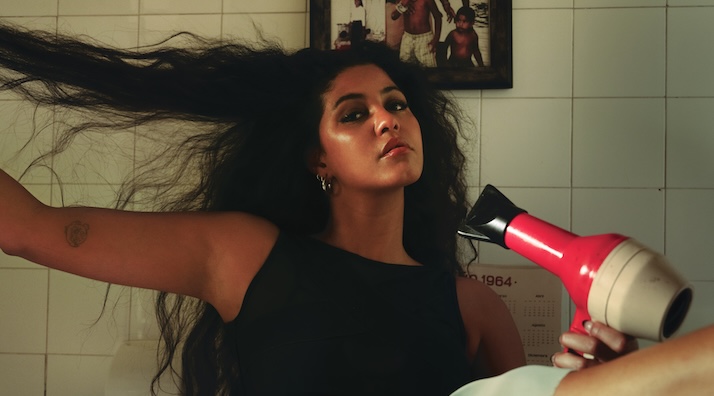
Photo by Karla Read
"I hope somebody finds something about themselves in the album," Yendry tells me from the Sony Music Latin offices in Miami. "I hope they treat the songs as little totems, where you associate one song with a specific moment of your life, or something you were going through," she reflects. This is a meaningful message for Como agua, Yendry's debut album, which has just been released. The album revolves around growth, migration, and nostalgia, with lyrics drawn from her lived experiences.
Sitting with Yendry in Miami, it's evident how personal this album is to her, and how much she protected it. "I needed to protect it and make sure it was 100% exactly what I wanted to say," she says. "It's my first album. It's scary. It's a leap of faith. I'm proud of myself for trusting my own instinct."
Sony Music Latin also hosted an intimate listening event where guests heard tracks from Como agua alongside fan favorites like "Nena." Performing acoustically, Yendry filled the room with the soulful energy that defines her music: passion, care, and an insistence on being fully herself. Yendry is both Dominican and Italian, her roots spanning continents, and that duality shows in her music, sound, and lyrics.
Yendry is also a genre-bending artist, moving effortlessly between bolero, pop, R&B, and more. She's inspired by Selena, the Bee Gees, and a range of other artists. "With this album specifically, I didn't want to give myself limits," she says. "Which is very ambitious." Listeners can hear that range from her bolero single "Mala Mía" to the bounce of the Latin-pop track "Mentira," built on the Triton-keyboard sound she grew up watching on MTV.
"I feel that we all have a similar story, but we don't talk about it that much," she says. "Especially in art. I was seeking people sharing their immigrant experience just so I didn't feel so lonely." For Yendry, Como agua is as much a journal as it is an album.
From COLORS to Lollapalooza Paris to touring with ASTROPICAL, Yendry's music has traveled across the world. With Como agua, she's sharing important pieces of her life with listeners.
What has been the process of building your album from start to finish?
It's been hard to trust my own ideas and decide, "Okay, I'm gonna do this," but also, I gotta say, protecting them. I think when you're working on a project, you are the only one that sees the vision at first because it comes from you, your feelings, your stories, and everything. You have to protect all of that in the process, and protect yourself also from being open to feedback, but also protect yourself from opinions and what you know people think you should do. I really wanted this album to be personal, very honest and straightforward. For that reason, I needed to protect it this way and make sure that it was 100% exactly what I wanted to say. It's my first album, it's scary, it's like a leap of faith. I'm proud of myself for trusting my own instinct.
Your sound has fused bolero, R&B, pop and more. What experiences and influences pulled you into all these different lanes?
I think whenever I go to the studio, it depends on the day, because you write a lot based on your mood or what you're going through at that moment. I'm obviously a result of everything that I listened to in my life, and everything that I've been exposed to as a kid. As a kid, my mom used to play Selena and La India, a lot of bachata, and a lot of merengue in the house. But also, my Italian dad was playing a lot of Bee Gees, Whitney Houston, Michael Jackson, and Barbara Streisand. I feel like when you go to the studio, you can't really think, "Oh, I'm gonna do this, I'm gonna make that." But definitely those influences just come up at the moment. For the bolero, I wanted to write a song that doesn't feel like it has time, a sort of timelessness. One of those songs that you hear and you're like, "This feels like a classic." I'm not saying my song is a classic. I'm saying that's the feeling that I wanted. Or like "Mentira," "Mentira" is like I grew up with all those Neptunes productions on MTV, watching these music videos on MTV, and we used this keyboard, the Triton. It has those specific sounds, and I wanted it to be bouncy and fun. I feel like I go from one genre to another, not thinking, "Oh, I'm gonna make a merengue," but it's just like something that happens on that day, and I, with this album specifically, I didn't want to give myself limits, which is very ambitious.
Family, migration, nostalgia, growth — these themes run through the new project. Why was it important for you to include these in your project?
I feel that we all have a similar story, but we don't talk about it that much, and especially in art, I was seeking people sharing their immigrant experience just so I didn't feel that lonely, I guess. And so for me, music was a sort of therapy for myself and my own journal. I treated this album as my own journal, and that's why in there you'll find the family, because I really miss my family and I really love my family, and I put them first. You know, they're in my column, or the grief of who I was when I was in another country, or the loneliness that comes with being an immigrant. You have different sides of yourself that some people won't see and won't know. My Italian family doesn't know me in the Dominican Republic, or my Dominican family has no idea how I am in L.A. speaking English or having that kind of life. I think all these things just came naturally to me in the music I make because of that. I write a lot about stuff that I go through.
I think that's so important nowadays. There are so many immigrants in this country, and I think people can relate to you. Not many artists, like you said, want to speak about those experiences and be open about it. But I know little girls probably look up to you and your stories. I think it's really cool that this project and everything you stand for is for the immigrant experience, and it's good that other girls can see that it's okay to be an immigrant, it's okay to be loud and proud. The message is very important for people to understand when they listen to this project.
The immigrant experience is universal, but a lot of people talk about it in a political way, and they don't think about the human side that's behind it. Each one of us has our own story, our own battles, our own problems and issues. And even with "Espejo," people are like, "Oh, that's a very particular story." I'm like, "No, this is the story of a lot of Latin families." Even my African friends in Italy have a similar story. It's just people who migrate and families that get separated from each other because of money, papers, documents, and just life sometimes. I wish we could see it from a human side, because it's a human experience. It's not an immigrant experience, really.
You’ve said “‘Mala Mía’ is like a goodbye letter to your old self.” What does it feel like now to know you’ve said goodbye to that?
I feel so liberated. I feel like the girl that was in Italy, who always wanted to go live somewhere else and just disfrutar (enjoy). But you have to pick those opportunities. I always felt like I had opportunities somewhere else, and I wanted to go. When I was in Turin, somehow I felt the responsibility of being there for my family, and sometimes we don't believe in ourselves. We're like, "Que voy a ser allá?" (What am I going to do there?) You have to be brave to move to another place with no money and be like, "I'm just gonna try to do this. Let's see how it goes." I'm liberated from that. And in "Mala Mía" as well, I'm talking about it from a relationship perspective, but it's really me living, "despidiéndome de un lugar de las expectativas que los demás tenían para mí" ("saying goodbye to a place of the expectations that others had for me").
How did the movement, the dialogue, and the camera angles all come into play in bringing the “Mentira” video and song to life?
I wanted to move in the music video because I was like, this is a fun song, I can't take myself too seriously. And Katharina, the director, envisioned this. She asked me, "How do you see this?" And then she molded it. I feel like it's really cool because, first of all, it's not like a strict video. It's not that I have choreography, I'm just moving like crazy stuff. But what I love about it is that it feels like we're in my house, and you know, my grandma, who's in the video, and mis primas—they ask my grandma, "Where is she? Did she fall in the bathroom?" And my grandma's like, "Oh, you know, she's always in her own world." And I'm like, in the bathroom, just like dándole todo, metiéndole todo, just finding what to wear and dancing and having my own concerts, which is what I grew up doing. And I feel like my family didn't really understand what is she up to, what is she doing, and "Mentira" is also about that, like faking it until you really believe that you are that. I love this video. It's one of my favorite ones.
I caught you in D.C. with ASTROPICAL, Bomba Estéreo and Rawayana. What was it like sharing that stage and touring alongside them?
It was really cool. I feel like I wasn't prepared for the fact that their concerts and shows feel like a party. There was a good vibe in the audience, and the audience was really nice to me. Normally, when you open for someone, those people aren't there to listen to you, but it was a really good experience. I would say Li and Beto are really nice people. It was very easy for me to be on tour with them. It's a beautiful venue by the water, too.
What’s the first thing you want someone to feel the moment they press play on Como agua?
The first thing I would say is, you make something and you want people to like it. But more than liking it, I hope somebody finds something about themselves in the album. I hope they treat the songs as little totems, you know, where you associate one song with a specific moment of your life or something you were going through. I hope they find that one song that helped them do something, or that made them feel a certain way. I'm not looking for people to just say, "Oh, I like it." I just want people to experience it. That's it.
Listen to Como agua below:
![Moody Joody Draw Us Closer to their Debut EP, Plain Jane [Q&A]](https://s3-us-west-2.amazonaws.com/onestowatch-v2/unnamed-1791228468.jpg)
![Everything You Need to Know About Janine Berdin [Q&A]](https://s3-us-west-2.amazonaws.com/onestowatch-v2/save_vid._net_825323764_18639518701012760_1512066654651545567_n-1791395650.jpg)
![La Niña Is Learning to Let the Unknown Lead Her Ahead of US Debut [Q&A]](https://s3-us-west-2.amazonaws.com/onestowatch-v2/eleonora_albano-_d_s_c05998-1791394944.jpg)