80s Disco-Funk Is Alive and Kicking in Midnight Generation's 'Rooted' [Q&A]
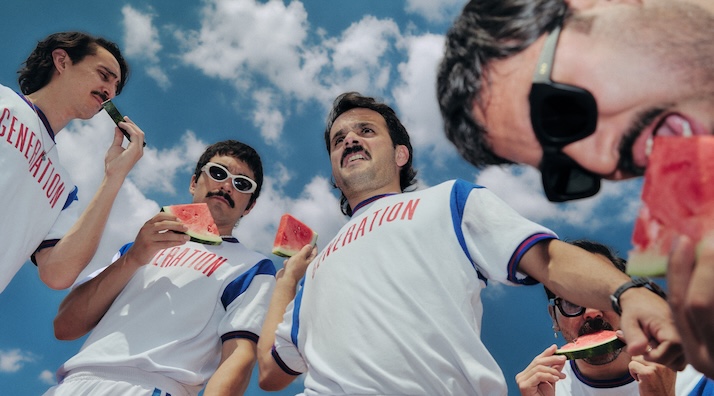
Ready for a visualization exercise? I want you to close your eyes and imagine yourself in a club in the 80s. You are in Mexico and the desert air is warm. The disco ball is shining, the groove is setting in and you are wearing a colorful little outfit. On stage you can hear something like Daft Punk playing, the signature disco-funk and electronic indie-pop sound is making you move and a sometimes robotic voice peaks your interest. You go to the stage and see five guys in matching tracksuits and mustaches performing, synths are everywhere and as the rhythm takes over - all you want to do is dance.
Okay, now back to reality. It's often only when we are furthest from home that we start to truly appreciate everything that home is, as well as all the things and all the people that made us. For Midnight Generation, a band stemming from Chihuahua in the north of Mexico, that exact sentiment is captured in their latest album Rooted. After a whirlwind year that had them touring the world and seeing new people and places, it only seemed logical to write up an album that captures where you came from.
What's special about the band is that their music not only serves as a portal to their roots, but also as a portal into the past and future simultaneously, where the concept of retro-futurism inevitably comes to mind. "Being inspired by '80s music is part of what makes us special. We like to record the way they used to, with analog gear and keeping things simple. We believe that's how music sounds best", says lead singer Fernando Mares.
If you have seen them on social media, you'll know that they take that seriously. Videos of their synth and keyboard plastered studio with a colorful carpet to match have gone viral, showcasing their funky style and production process. With Fernando sometimes using a talkbox to create the signature robotic voice sound that is splattered across their songs.
Beyond the sound, the album's ethos can simultaneously be described as wanting to have borderless fun, undergoing a search for love and belonging, but also being acutely aware of the state of the world. The latter sentiment is what struck me most during my talk with Fernando and fellow band member Carlos Amaya, namely how heavy topics are playfully and masterfully injected into each track. For example, in ¨El Rap de Piter Pan¨, the only Spanish language song in the album the band is "making fun of an audience that gets annoyed by seeing us shine, you know? Because ever since we started this project about 12 years ago it’s been a process of adapting¨ says Fernando.
During our talk we touched upon making art in a ¨plastic world¨, what it means to be a Mexican band primarily writing in English, and the importance of going analog in 2026. With a tour that will take them from South to North America, to the Caribbean and Europe, Midnight Generation is ready to bring their Chihuahua-infused, funky retro-futurism around the world and you better get your dancing shoes ready.
*Interview has been translated from Spanish and edited for length and clarity
OnesToWatch: Hi Midnight Generation! The new album is called Rooted. So, I’m wondering, what do “roots” mean to you?
Fernando Mares: I think roots are those little things you can’t see in a person. For me, roots are how you were born, your parents, the things that helped you grow up, right? From a young age, for us in this case, it was music. Also, living our whole lives in Chihuahua, which is a border state (with the US), influenced us in a certain way. The truth is, it’s not such a deep topic, but more about who we are and having a very special pride in who we are and how we present ourselves to the world.
Carlos Amaya: I see roots in how each of us experiences music and how we seek to return to that feeling we each had, right? For example, for me it might be a form of play, expression, curiosity, and so on.
Can you tell me how you started working on this album?
Fernando Mares: Well, it’s really just the way things go. Every time you finish an album, you start the next one. We had several ideas, textures and sounds in mind, but I think every album takes shape based on what you’re going through and your current situation. At the time we were writing, we weren’t used to touring and to missing the people we love so much. We hadn’t been to so many amazing countries and we hadn´t met so many people all at once. It was very inspiring and a very new experience.
Your style is incredibly retro-futuristic. It makes me think of video games from the 80s like Tron, Guitar Hero or Distance. I wondered what you would do if you could spend a day in Mexico in the 80s.
Fernando Mares: (laughs) Music would definitely be even better if we lived in the '80s. We wouldn't be so overwhelmed by technology. But we also like to think that being inspired by '80s music is part of what makes us special. We like to record the way they used to, with analog gear and keeping things simple. We believe that's how music sounds best, and that's how it's meant to sound.
I think one of the really great things about your music is that it immediately makes you want to dance or feel that energy—and I feel like we’re seeing a time when everyone says the dance floor is dead. So, I wonder if you’ve had the experience of seeing the dance floor die out, and how do you view your music as a way to inject that energy into the audience?
Carlos Amaya: That’s an interesting question. I don’t think that’s ever happened to us. I feel like our music, in and of itself, is always born out of a desire to make people dance and have fun. Of course, the response depends on each audience and each country—some dance more, others are louder but move less. I think we’re lucky not to be witnessing this “death of the dance floor.”
Fernando Mares: Yes. And I think it also has to do with the way we do things and the fact that our roots are more inspired by the past. I think this "dancefloor death" might be due to how plastic the world has become, or the role technology has played in music today, and how there’s music that lacks genuine emotion and is driven by capitalist demands. Also, expectations and consumption patterns for music are different now, aren’t they? People are expecting different things, and if you give them what they expect, well, that’s the worst mistake an artist can make, isn’t it? The artist has to create without thinking about how the audience may react to it.
One song from the album that really stood out to me, and not just because it’s the only one in Spanish, is “ El Rap de Piter Pan.” What can you tell me about the song?
Fernando Mares: “El Rap de Piter Pan” is a comedy of sorts. It’s also a little silly because we don’t really know that much about what we’re saying, you know, we were just trying to rhyme. Thematically, in the lyrics we’re making fun of an audience that gets annoyed seeing us shine, you know? Because ever since we started this project about 12 years ago it’s been a process of adapting. It’s really funny how, from the very beginning, people called us “malinchistas” (someone who doesn´t appreciate where they´re from) or asked why we didn’t sing in Spanish if we were Mexican.
As the music evolved until we started gaining fans who actually liked it and shared it. And then last year, with all the buzz around the release of our last album, a lot of new people started coming in from all over. But that means we got a lot of hate too, and honestly, it was super funny to read some of the comments, even though we never respond to them. But we do read them and poke fun at that too.
There’s another song that really stood out to me because of its more rock-and-roll style: “Can You Tell Me How You Feel?” I wanted to see if you could tell me how you came up with such a different sound.
Fernando Mares: The lyrics are kind of about that awareness that I think we’re lacking about what goes on in the world. Sometimes it really breaks my heart to see the huge disadvantage animals face compared to humans. I mean, it’s one thing to be at a disadvantage, but it’s another thing entirely not to be aware of it. And that’s exactly what the song is about—how the world is going to s*** because of this lack of awareness.
As for the sound, I don’t remember exactly how it came about, but it started with a synthesizer sound that sounded super violent —kind of like a distorted guitar—and we were like, “Ah, this is super cool.” Then we bought a new synth where you just had to press a button and it made a siren sound—and we were like, “Okay, this is awesome.” We were heavily inspired by the sound of Soulwax for it.
What are you looking forward to the most about performing this album live especially with your interesting backstage concept which you unveiled in Puebla?
Fernando Mares: We're really excited to bring everything we've created for the new album to the stage: a whole new visual experience, more instruments and new textures. We believe the traditional format of going to see an artist play real instruments should never die, and that those instruments should sound as natural as possible live.
Who are some artists you’ve been listening to a lot lately?
Carlos Amaya: I just recently started listening to Super Taste. They seem like a really talented group of guys, and their music is really interesting, funky, and fresh.
Fernando Mares: I could mention some friends who I’ve always thought are incredible. They don’t follow the industry’s rules to gain followers, and they’re incredibly talented. They’re called CAPYAC, and everything they do is super fun, super funky,
Listen to 'Rooted' below: