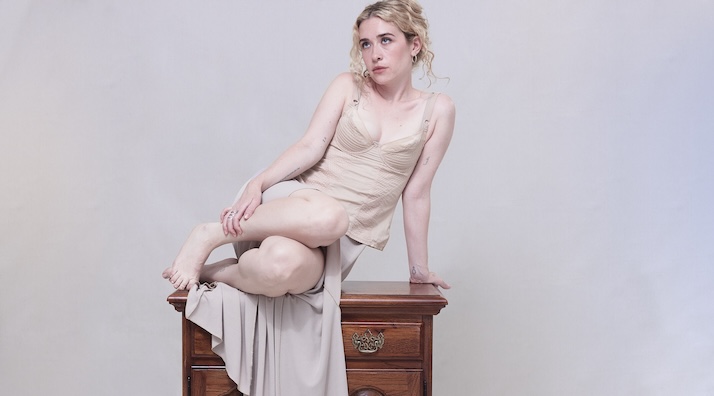
GIULIA BE: The Brazilian Popstar Who Chose To Just Be Herself...In Three Languages [Q&A]
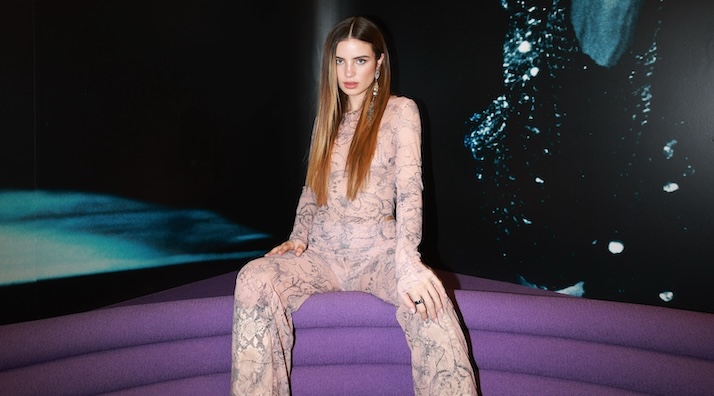
Photo by Christy Barley
Now LA-based, Brazilian popstar GIULIA BE is gearing up to release her second, eponymously titled album and the excitement is real. The singer, songwriter, composer, and actress won everyone over with her 2020 breakout hit “menina solta”, leading her to make a mark and be the youngest Brazilian to ever be nominated for a coveted Latin Grammy.
After pondering over what her artist name should be, she ultimately chose the most radical option of all: just being herself. "Just be Giulia, I chose the name and it’s the best name," her mom told her. And so GIULIA BE was born, a name that doubles as a manifesto, and now her latest 21-track album.
The result is a project that is carefully and meticulously layered, and feels extremely authentic to who GIULIA BE is. Perhaps the most talked about thing surrounding this project, is the fact that it is separated into three EPs, each written in a different language: Spanish, English and Portuguese. What is clever is that she intentionally introduces each of the languages in a way that’s accessible to the listener, before letting them dive deeper to discover each character’s vulnerability. Using an array of genres that will feel familiar, she moves from catchy pop, to danceable reggaeton and slowly eases you into who she is at her core: a ballad-loving songwriter.
What is most fun is that her songwriting style manages to perfectly situate you and set the scene. From the awkwardness of “grillos” after not getting an “I love you too”, or the “girls want to have more than fun” lyrics, or not wanting to grow up in “Peter Pan”, the project is relatable to say the least.
This is an album that grapples with the two, or in this case three, wolves that we all have inside, is woven through intricate layers revealing that what seems like three separate EP’s are actually part of a whole. In the same way that Spanish, Portuguese and English speaking GIULIA BE - or as I have been calling them: Julieta, Giulia and Julia, are all one and the same.
GIULIA BE took Hamlet’s “To be, or not to be” and said “all of the above”, having that spirit run through the DNA of the album. For her, writing across three languages: Portuguese, English, and Spanish, was never a calculated market move. It was simply true to who she is. "It's not like I'm forcing myself to write in English because of a marketplace," she tells me "It's quite the opposite.” Each language unlocks a different GIULIA BE: the soulful, vulnerable girl from Brazil in Portuguese; the pop-savvy, emotionally sharp Julia in English; a language she has progressed into writing more in, especially after moving to LA. And finally, the confident, party-ready drama queen in Spanish, a language she learned when moving to Miami at 15.
Between wedding dress shopping in Barcelona, a film hitting the screens, and an upcoming trip to Mexico City (where I was more than happy to recommend the best spot for flan); I sat down with GIULIA BE to talk about her upcoming album and what went into writing in three different languages, creating not one, but 21 original music videos and intricately building an album full of layers. And I have to say, her way of thinking blew me away. This may just be her trilingual recipe to take over the world.
OnesToWatch:: Hola Giulia! Hi, how are you?
GIULIA BE: I’m doing so good thank you! I love your postcard wall, I just got back from Portugal and Barcelona, and I got some postcards too, they are just sitting in a folder though [laughs].
Maybe my wall can be some inspiration. I would love to talk about your upcoming eponymous album, which is so exciting. Tell me first of all why you chose to be called GIULIA BE as an artist?
So it came after me heading to the bookstore and buying probably every single book on mythology they had, and looking desperately for an artist name. I went through all of these different creatures and deities, but nothing felt right. After having a conversation with my mom she just goes like “Just be Giulia. I picked the name and it’s the best name.” It came from me just wanting to be Giulia and I like that you can use it as the beginning of so many things like: be yourself, be confident, be strong, be ambitious.
Do you feel like, as an artist, you sometimes get to have that separation from who you are in your daily life?
100%. I feel like there’s definitely a little key that I turn whenever I’m GIULIA BE.When I go on stage especially, sometimes I don’t even remember a lot of the things that happen on stage because it’s a fully different part of my brain. On your day to day, you wouldn’t flip your hair and hold the mic like this, but on stage, you kind of have to. So I definitely feel that there is a separation there that is honestly welcome. But I do like having access to GIULIA BE whenever I’m just Giulia, if that makes sense, like it’s an extension of me.
Speaking of you having this duality, in the trailer you made for your upcoming album you have three versions (or characters) of yourself that you are kind of choosing between at first. I wondered if you’ve ever felt like you had to stick to one path, like choose to be either the pop star or the sentimental ballad star?
Whoever speaks more than one language knows that you can’t really be the same person exactly when you’re speaking a different language. Some things about the way that you communicate and the way that you express yourselves are different. I love exploring my pop star side. I'm a Leo, so I love the sparkles and the dancing and the production, but when it comes to what I love most: writing, I would say ballads are where my heart lies. I just love sitting at my piano and pouring my heart out and figuring out what I want to come from there. And I feel like this project is thankfully a mix of all of those things that I love.
I love how in each of the language EPs, you have a progression of starting the songs with sparkle and pop, and then by the end you’re kind of into sad ballad, more profound territory.
I’m really happy you noticed that because it was 100% intentional. I think when you start seeing the characters, in their own little worlds, you meet them on the surface, and as the characters start revealing themselves, they get more vulnerable. By the end, you start to understand that something that looked like three very different artists in the beginning kind of trickles down into the same girl. I really wanted people to feel that as well and to see the layers.
I love that, because indeed when you first glance at this project and one of the main things everyone has been saying about it is that it’s divided in three languages so it kind of seems like this separate thing that became a whole. And as you said, you kind of have a different personality in each language that you sing in, on this album. I was wondering how you connect to each language differently?
That’s a great question. I think they’re all in different tabs in my brain. Giulia in Portuguese is the Giulia that I grew up being, the one that is having to move out of her home, the one that grew up with all these friends, and the one that went through most of the traumas. So, I feel like I connect with her when I’m at home with my family, when I’m with my older brother writing music.
With Julia in English, I’m now getting married to an American, and I spend a lot of my time speaking in English to my team as well. It’s so funny, every time we have a meeting of the full team, literally the meeting is in Spanish, English, and Portuguese, which is a blessing to have such an international team.
And for Spanish, which was the last language of these that I learned. When I was 15, I moved to Miami and I had to learn Spanish to make friends. And I’m grateful because they introduced me to so much amazing music. So, Spanish speaking Giulia is very confident, dramatic and she loves a good party.
Very relatable honestly. It kind of felt like you attached certain genres to each, so the Spanish-speaking Giulia leaned more into reggaeton, whilst Portuguese was a bit more jazzy and soulful. English was pop and soul.So I wondered why you kind of chose to attach these genres to each.
One of the hard things about doing a trilingual project is that each of the parts of the project is almost being catered to a different sort of market in a way and and I think that because I’m singing in that language I allow myself to explore those genres fully. Even in English I start with some very pop disco tracks and eventually waterfall into the ballads. With Spanish like you said, exploring these dancehall rhythms that I don’t think any of the other Giulia’s would be able to explore. And Portuguese is kind of the same thing. I kind of stuck to my roots and stayed true to that singer/songwriter, because it’s more vulnerable and it’s what my audience knows me for. It wasn’t a conscious choice when I was making the music, but it was a conscious choice when I was picking which songs would make it onto the album.
Okay, so you chose a way that you know people will listen to it and relate to it a bit more.
Yeah, I chose in a way where I wanted to create layers and wanted the first songs to be accessible and not overcomplicated, and once you’re in the roller coaster you come along for the rest of the ride and get to see all those layers to the music.
Was there ever a point where you were a bit scared or hesitant to release music in two languages that are not Portuguese?
Yeah, I love that question. Because I feel like especially as a Latin artist, people try to put you in like a box of what you’re allowed to explore. And it feels very not only cathartic, but exciting to be able to like, do it because it’s not like I’m forcing myself to write in English because of a marketplace. It’s quite the opposite. I’ve always written in English and despite the market having resistance to it, but I still want to put it out because it’s authentic to me, and same for Spanish. I still get a little bit of a backlash, but in a world where a Korean English song can be the number one song on the Billboard charts, anything is possible. And I do agree with you that people are opening up slowly to that a little more, like Rosalia just did 13 languages in Lux. So who knows? But I definitely am just excited for the music to reach these different audiences and not really have to worry so much about the backlash.
I was wondering if you have any tours or shows prepared to maybe bring it to other parts of the world?
Yeah, so we’ve been doing showcases and we’re planning on having a tour next year. I really want to do some festivals and hopefully some other shows as well, not only in Brazil, but in Portugal and Spain, hopefully in some places in the US as well, hopefully Mexico.
I saw that you’re not only a songwriter on everything you do, but also compose a lot. I was wondering if you could, in a maybe technical way, walk us through your songwriting process.
I’m very much a lyric -based songwriter. you know to the point where a lot of times it can be annoying to produce with other people. They're trying to bang out the song, and I’m like “What’s the story and what is the character doing?”, because that’s just how my brain works. I love starting with the story, be it a phrase that sparks a story. I don’t always know exactly where I’m going, but I need to know at least what I’m trying to write about. Afterwards, I'll create the melody for whatever words I need to fit into that place. I always say that before being a singer, a songwriter, or an actress, I’m a storyteller. That is why God put me on earth, and I’m very grateful to have acquired the skill along the way to be able to translate emotions into feelings. A lot of times friends will sit down and tell me stories about their life as well, and that is such great source material for me.
How do your friends feel about that?
A lot of friends have come to me saying “you should write a song about this thing that happened to me” (laughs). I used to do this thing in my Instagram called the lyric challenge that I've done ever since I had like a hundred followers, and still do to this day on occasion, where I ask people to send in their stories and then I will create like verses or sometimes a full song based on their stories. And it's just fulfilling to be able to be an online therapist in a way.
I wanted to ask you about the music videos. You didn't just put out a video or two but, one per song, where each one is a very specific scenario and a very specific character. So how did you come up with them?
It was a very collaborative process. I had Olivia Mucida, who was the director for all of these music videos and Lennyn Salinas, who is the creative director at Sony and we really put a lot of time and went into a three -month deep dive creating structures and the arc for all of these characters. I've directed my own music videos before. I love that part of it. I´m a huge fan of watching music videos, and to be able to be such an integral part of the creative process for these 21 videos was awesome, to put it lightly.
Do you have a favorite one so far?
That's a really hard question. I'll give you one favorite for each language. For Spanish, I really love the "Bebecito" music video. That was an idea that Olivia had of me just kind of hugging man and we have an arrow coming through both of us and we're both bleeding. It's just such a beautiful image, a very simple video but I just think it's just so vulnerable.
For Portuguese I would say it's "Peter Pan" because that was a video where I sent the editor a bunch of my home videos from when I was a little kid and he edited it into a compilation. When I watched it I just sat down in a little bed and watched it and I cried like a baby. It's a song about not wanting to grow up, so it was very emotional.
For English, "911" or "Closure." The "911" video, we actually shot way before this project started because I was going to release the song and ended up not putting it out. "Closure" is such a cool video of a burning house and I'm wearing this incredible Couture dress that's burnt all over as well. I'm really excited for people to watch that one and that was one, because I had that vision since we made the song. It's also the last song of the album so it feels appropriate and symbolic.
Who are some of your artists to watch?
Mckayla Twiggs. I love her 2014 tumblr aesthetic. Also a great friend of mine and an amazing artist: Remi Bond. I love her and I hope I get to collaborate with her very soon. There's also Spencer, I love how dramatic he gets in all of his lyrics and the way that he builds it is true pop rock.
Listen to GIULIA BE below:
![OSTON Examines Her Own Self-Discovery From A Bird’s Eye View on Debut Album ‘Isn’t That Sweet?” [Q&A]](https://s3-us-west-2.amazonaws.com/onestowatch-v2/a_u_s_t_i_n-6-24-1790280524.jpg)