Joshua Jensen Believes “Music Makes the Universe Visible in our Ears” [Q&A]
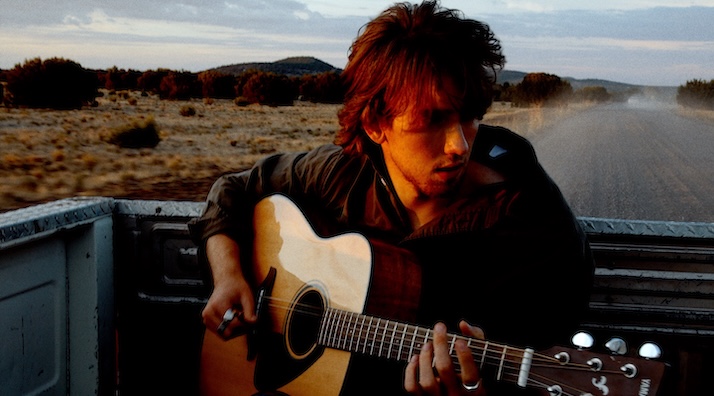
Originally from Arizona, rising singer-songwriter Joshua Jensen grew up envisioning his life as a Broadway conductor, or a classical piano player. Then, he found songwriting, which he says allowed him to come to terms with “everything I love about art.” Now, he is living his life and growing as a contemporary spiritual figure and band leader in New York City.
Taking full advantage of the city’s vast musical opportunity, he recently performed alongside Suki Waterhouse for her performance of her Loveland tune “Weirdo” on The Tonight Show with Jimmy Fallon, and leads several collective musical gatherings for those seeking a faith-based community. The going-on’s of such gatherings can be found on his social media, highlighted by the distinct and powerful chorus of voices he has brought together.
He’ll also perform at Greenwich Village’s Church of the Village this coming weekend, partially in support of his new EP, Bear, out on February 2nd. His latest single, “Favorite Blue,” is out now.
Led by its focus single “People Were Singing,” which premiered as a World First on Zane Lowe’s Apple Music 1 radio show back in late September, Jensen’s project is a singular reflection of Gen-Z’s overwhelming surge towards religion and spirituality. USA Today reported the findings of a Harris poll suggesting that, “Gen-Z adults – those aged 18-29 – aren’t just embracing religion at higher rates… but spiritual practices in general, including meditation, astrology and energy work such as reiki and tai chi.” In just one example of cultural relevancy, this has become especially prevalent on recent seasons of American Idol, during which entire episodes have been dedicated to faith-based music. A performance of original tune “Hey Jesus,” sung by rising act Baylee Littrell, during the show’s 2025 season, was especially riveting.
"People Were Singing,” which Jensen says receives its highest streams weekly on Sundays; “These people are coming to church, to my music,” acts as something of a collective testimony as he is joined by a literal chorus of voices, though other tunes on the record are equally potent, if not more so. “Hoping,” the grandest of the bunch, sees him on what could be considered a higher musical plane, and is an utterly thrilling listen.
A wonderfully skilled vocalist all-around, Jensen, who added production skills to his belt whilst cooped up in a cabin early in the COVID era, remains unvarnished on many of these tunes, particularly on the ruminative “Half of the Tree” and the melodically efficacious “Maybe Home.” “No one is ever impacted by a super capable singer,” he said when discussing the usage of AI and/or what could be deemed as a “perfect singer.” “We care about that rawness.”
“Favorite Blue,” while a bit of a sonic outlier, rounds out the EP, and is particularly special for Jensen due to its subject matter surrounding loss, and the memory of it. Perhaps most impactful is “Maybe Home,” the inward closing track with a profoundly transformative passage: “Maybe home is in a whispered prayer, in a burden you bear/ You have to let it change you, cut you down, and split you open, and gently rearrange you so you don't burn out so fast next time around.”
OnesToWatch: It’s said that you “have a knack for reaching up into the sky with open hands and coming down with songs that are fully formed.” Can you describe your first experience of that and, if you had had any prior connection to faith, how is that different?
Joshua Jensen: Music has always been super spiritual to me. it's about living your life, being mindful and noticing things that are intriguing to you, and taking a big database of the world and of your own feelings and experiences. Some days a song will just appear, and I feel it coming, and I'll just try to bring it down. That's something I'll always try to do in life… to see if the songs resonate with people, and I'm at the very beginning of seeing people respond to them. That practice makes it sound like something that I'm trying to do like so that people have this magic connection to it, but it's really just how I process life and how I want to serve people.
How do you see the process evolving as you progress within your faith journey and your musical journey?
Music has always been the greatest God we have to worship. And it's something so universal, that we all gather around the prayer of music. Music is a celebration, and an expression of humanity. Humans love harmony and harmonic pitch that follows after the pattern of nature and gravity, and the way that the universe functions. Music makes the universe visible in our ears.
My faith adventure have been years in the making. I grew up very religious, and, in many ways, I am still very much tied to the practices that I learned growing up. Even if I'm not as attached to the institutions that I was raised in, I very much respect the spiritual practice that it instilled in me. And now, my job is to build bridges between all people and all faiths. A lot of writers in my generation feel that way. A lot of us were raised in more orthodox traditions, and are now finding a higher sense of consciousness that allows us to still have a spirit of worship and a spirit of divinity and. So, we're finding it together. It's something we have to ask questions about, and read all types of literature and scripture and ancient text. We have access to all of it now, so I can't help but feel like we're all called to a higher plane of being a good human.
“People Were Singing” seems to be a collective based testimony, of sorts. What do other people's voices do to aid that said testimony?
Mm, that's a great question. I was joking with some people on my team because my streams are growing slowly, but they're always highest on Sunday. And I was like, “These people are coming to church, to my music. They're coming to sing.” I think gospel music is the greatest music of all time. It’s the most free, and it just captures you in such a way that nothing else ever will for me. So, naturally that bleeds into the music I make when I'm thinking of harmonies and the messages. “People Were Singing” is about feeling super alone in a room full of people and feeling like everyone's in love, and everyone's falling in love, except for you, and you don't get to experience the world the way other people are. But, the reality is many people ARE in love and feel even more alone. Especially in New York, we all walk around and everyone has their guard up. The second you can express to someone that, “No, I have my guard up too. I see you,” then everyone can bring their walls down and have an experience together.
Is it a gift, a curse, or both to be able to have songs, or any sort of like musical element, come to you in the way that they do?
It's a huge blessing and a curse in some ways. It does feel like a lot of pressure. but it's also just fun! You get to write songs in your bedroom, and you don't really think anyone's going to hear them. And now I'm getting twenty plus messages a day about “People Were Singing.” That's how it is. Your best ideas are the ones you're most afraid to tell. You just have to be fearless and realize we're all here for a short time. We should just enjoy this life and be there for each other, but also be focused on the really hard stuff going on, and we need to ask some big questions and show up for people in a big way. I'm still learning how to tap in and show up for the voices that can't.
Is it easier to show up for people in everyday life than it is in song form?
Sometimes, yes. I'm learning about the process of just living and being a normal person, and then trying to be the artist. What I'm learning is that the more you try to separate the two, the more disconnected you'll feel. You just have to bring them into the same room and feel equal parts of yourself in every room that you're in. Even if that means being annoying to your friends, like “I need to write this idea down really quick,” or, “What did you just say? Say that again.” But, I've had a lot of different characters in my life, from different groups of people, and those have kind of melted away now. What's cool is when you are just you, and you're centered, and you're yourself, other people feel that and they match that. Or they won't, and their walls will reveal themselves really clearly. The same way as a song. In a song, there's so many different versions and ways that a song could go, but there's always a center version that's like, “This is the exact drum sound that I want,” or “This is the exact tempo marking or the dynamic” or whatever it is.
As a kid, I was a classical pianist, and I would compete around the state and then around the country in high intensity competitions where you could win something like $15,000. It taught me how to zero in, focus, and have an exact vision and see it and hear it in my head before I would go on stage. Sometimes it works, sometimes it doesn't, but now I'm just applying that. I have so many ideas with all the music I want to make and, I just hope I have like enough time in my life to put it all out. That's literally my one problem. I have no other issues in my life. and no one could hear it! I could just be like a little artist my whole life and that's fine, I just want to put the music out.
What effect do you think that vocal rawness impacts or aids the listening experience for a song like “People Were Singing” and “Half of the Tree”?
There comes a day in every singer's life, or even every songwriter's life, where you have to decide, “Okay, I'm gonna decide to like and celebrate my voice and to be okay with its rawness.” I'm not gonna sound like Whitney Houston. Sarah Vaughn. Dinah Washington, Chet Baker, Jeff Buckley. I'm gonna sound like me, and I just have to be fine with that. Once you get over that, you start to have fun and realize the things that you've been through are in your voice. And everyone has that.
Those songs, I sing them in one, two takes. “Half Of The Tree” is one take all the way through. “Hoping” is a little bit of chopping takes up. “People Were Singing” probably two takes all the way through. Play the song a few times, feel its energy, then just sing it, and that's the record. We didn't have Logic Pro in the freaking seventies. They just had to sing it to tape. And so, far fewer people were getting record deals, and far fewer people were famous, because they didn't have auto-tune to like sound way better than they actually do. I get that auto-tune is an artistic choice, but sometimes I just want to hear how you actually sound. We had stars doing full choreography with no auto-tune. The less layers between us and the audience, especially now with AI, the better. You can make audio sound incredible, like a “perfect singer.” We don't want that. No one wants a perfect singer. Nothing perfect and nothing super polished ever hits you. We care about that rawness. So, I've embraced that. I made this entire record with three microphones and two guitars in my bedroom.
What led to the reflective mindset from “Half of the Tree” where you're talking about “Nobody plans to garden for the weeds, nobody plans to die in their sleep”?
I wrote this song in the New York Public Library, The Rose Room. Big vaulted ceilings. There's a voice memo of me using these wired headphones and I very quietly hum the melody. It came to me along with the lyrics, and I didn't change anything. I trusted that it meant maybe something. Then I looked back at it, and you realize that some things in life just happen and don't really make sense. That's the beauty, but also the hard thing, about people. We revert away from nature. You don't plant a garden hoping there's gonna be weeds, but there just are gonna be weeds. And you don't plan to die in your sleep, but some people just do. It's a surrender to the ways that we have no control.
Also, there's a line in that song that says, “I didn't choose to whom your love was granted or where to bury you. All I can choose is which day I'm going to grieve and which animal to feed.” That’s about when I'm back home in Arizona on the farm, no matter what I’m going through, at the end of the day, you just gotta be like, “Okay, I have to go about my life now.” You go into an animal-like mindset when you're grieving someone. It's a beautiful thing that our minds can keep us alive, and can keep us on the next decision, But, it's a tough thing to be like, “I just got broken up with, but what’s for dinner?” I'm not feeling that as much as I was when I wrote it, but that song definitely takes me back.
From a listener's perspective, “Maybe Home” and “Hoping” feel like you're on an elevated spiritual plane. From an artist point of view, or just as a human being, does it feel that way?
Yeah, those songs are very much from the heart. I want to talk about “Favorite Blue” too. It sounds like a fun upbeat pop song, and it is, but it's also a song about loss. The memory of someone is ten times more vibrant than what actually happened to them, and that's a very dangerous road to go down. That song goes all the way down memory lane. That's a beautiful place to go back to, and it's even more beautiful if you can remember someone for the way they made you feel, because that's a reflection of you. The path forward is always the backwards. Going back into the past, and going back into your history, and writing from that place or singing from that place can bring you back into the present. It's also just fun to dance and jump in the water. There's a lot of really hard stuff on the project, and a lot of skeletons in the closet. That song is the expression of how falling in love makes you feel like your life is going to be eternally blissful, and hoping that you'll find that again one day.
The title of the project is Bear. Is “Maybe Home” the song that references it?
Yep, you found it. It's about a beautiful deconstruction of the soul I've been through the last few years. And the title can mean whatever you want it to mean. I'm gonna say as little as possible about it because I love mystery and it's a mystery to me too.
Who are your Ones To Watch right now?
Oooooooh, my OnesToWatch. My friend Joelle Ben Said. She is a phenomenal songwriter, and I think she's gonna be the biggest, most sought after lyricist in the world one day.
I love new music. I listen to music that's coming out all the time. My friend Marie Dresselheis is the best. I think you should be confined to 100 artists max per year, and then you could just dive into someone's discography. I think there's a lot of music that's kind of bland being put out too. So, maybe there's two hundred thousand songs coming out every day, but there's only one good song.
Listen to "Favorite Blue" below: