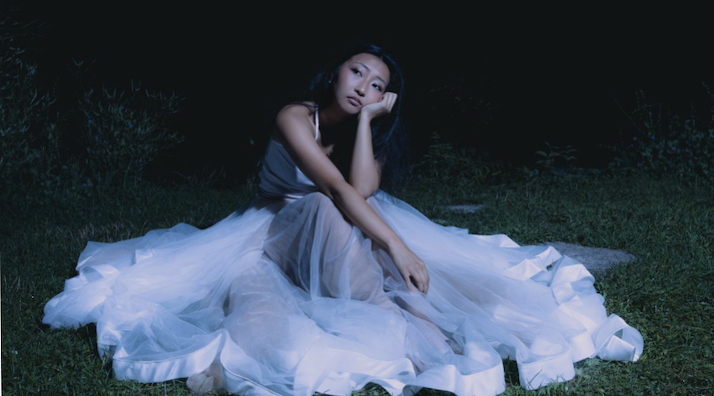
La Niña Is Learning to Let the Unknown Lead Her Ahead of US Debut [Q&A]
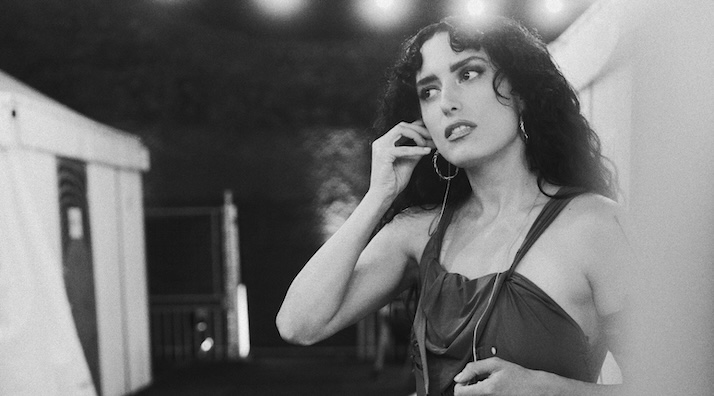
Photos by Kelly Rosa and Eleonora Albano
There are certain artists who make you curious about the person behind the music, and La Niña has always felt like one of them. The more her world expands, the more it seems to reveal about where she comes from, what she has lived through, and who she is still becoming. Rooted in Naples but never confined by it, she has spent nearly a decade turning her experiences, language, and cultural heritage into something entirely her own.
Now, that world is making its way to the United States. After a year of bringing her music to audiences across Europe, La Niña is preparing for her U.S. performance debut in LA, arriving at a moment of significant change. Alongside new music, including her recent single “RÀRECHE,” she has expanded into film, scoring Il fuoco che ti porti dentro and becoming the first Italian woman to score a film in the Venice Film Festival’s main competition.
What’s most interesting about La Niña, though, is that for all of this momentum, she doesn’t seem interested in having everything figured out. She talks about uncertainty as something she loves, about staying vulnerable, and about letting music arrive rather than forcing it into existence. Ahead of her U.S. debut, OnesToWatch spoke with her about Naples, artistic transformation, the freedom of not knowing what comes next, and what happens when La Niña’s music reaches somewhere entirely new.
OnesToWatch: You’re about to make your U.S. performance debut, after spending the past year bringing your music to audiences across Europe. What does it feel like to finally bring La Niña to the States?
La Niña: It feels a little surreal to be honest, I’m answering this question while staring at the ocean in Santa Monica, already realizing that the further I go, the closer I feel to some places. There must be something changing in my life that I still can’t fully understand. I’ve spent the last year traveling with my music, and every place has changed the way I understand it. Bringing La Niña to the U.S. feels like opening another door. I’m not coming here thinking that people need to understand everything about Naples or the Neapolitan language before they can connect with the music. I’m curious about what happens when you remove that familiarity.
You’ve described La Niña as something that came into being after a kind of personal death and rebirth. Nearly a decade into this project, what parts of Carola and La Niña still feel separate, and what parts have completely merged?
I don’t think they are really separate anymore. La Niña was born from a moment in which I had to destroy an old version of myself in order to become someone else, so for a long time I thought of her almost as another body. Now I understand that she is not a character, she is a language I created to express parts of myself that didn’t have another way out. Carola is the woman; La Niña is the creature that speaks through her. Sometimes I still need to distinguish between the two, but the older I get, the more they become the same person.
When you think about performing in LA for the first time, what are you most curious to discover about the audience and how they connect with your music?
I’m curious about what people will feel before they understand anything. In Italy there is an immediate recognition, the language, the rhythms, the references are part of a shared cultural memory. In Los Angeles I know that memory won’t necessarily be there, and I’m interested in what happens when the music has to communicate without that context. I think that can be very revealing, ‘cause I think you discover what is truly yours when you take away everything that people already know about you.
A lot of your music is deeply rooted in Naples and the Neapolitan language, but your songs have traveled far beyond Italy. What have you learned about communicating something universal through a language that not everyone in the room understands?
I’ve learned that you don’t necessarily need to understand the words to understand the intention. Naples has always been a place of contamination, languages, cultures, religions, sounds, people coming and going. Neapolitan itself carries traces of many different worlds. So I don’t see the language as a wall, I see it as a texture. The meaning can arrive through the voice, the rhythm, the physicality of the words. Sometimes not understanding a language allows you to listen to it in a more instinctive way.
You’ve said, “Tradition is not the past, it’s continuous movement.” What does that idea look like when you’re actually writing a song? How do you know when you’re honoring a tradition versus transforming it?
I do believe that in order to honor it you must transform it, otherwise it’s just a reproduction of something that already exists. Napoli has never been still. Its music has always absorbed something from somewhere else and transformed it into something new. That is the tradition I belong to. When I write, I’m not asking myself, “How can I make this sound traditional?” I’m asking, “What is still alive inside this tradition, and what can I do with it now?” If I repeat something without transforming it, I’m not really honoring it. I’m just reproducing it.
Your live performances have become such an important part of your artistic identity. After spending so much time on stage over the past year, has performing changed the way you think about your music or the way you write?
Absolutely. The stage has taught me that a song is never finished when you release it. Once you perform it in front of people, it becomes physical, you hear where they breathe, where they move, where they become silent. You understand things about a song that you could never understand alone in a studio. I think I’ve become less interested in perfection and more interested in presence. I want the music to be alive enough to change every night.
You recently released “RÀRECHE,” which feels like the beginning of a new chapter for you. What were you wanting to explore in yourself when you wrote that song?
"RÀRECHE" came from an instinctive place, but it is also a song about resistance. The question is, “What comes first, the earth or the flag? The cross or the prayer?” Before every border or imposed belief, there is something more ancient, the ground, the body, the possibility of growing. A flower can be broken by the wind, but wind without a flower carries no scent. Resistance is not always about remaining untouched. Sometimes it means being moved or wounded without losing what you are. The flower survives by staying rooted, yielding without disappearing. I was searching for that freedom in myself, not becoming invulnerable, but remaining alive and recognizable while changing. Maybe we are not defined by the storms we withstand, but by the scent we continue to release afterward.
You’ve said of “RÀRECHE,” “The flowers wrote this song, I only performed it.” What does it mean for you to let go of control like that when you’re creating?
I think control is sometimes the biggest obstacle to creativity. When I said, “The flowers wrote this song, I only performed it,” I meant that the music did not feel invented. It felt as if it had already been there, waiting to emerge, and I simply had to become quiet enough to recognize it. I never feel like the only author of my songs, I’m the person who allows them to come through. ‘Cause in the end I think that creating is not always about making something from nothing. Sometimes it is about listening closely enough to discover what was already there.
You’re also working on new music now. After everything that happened with FURÈSTA, the touring, and the response to your work internationally, what feels different about the way you’re approaching this next chapter?
Everything feels different, ‘cause I’m constantly changing. I love this uncertainty, it’s the core of my personality. I need to feel scared and vulnerable when making music, so I think it’s a good sign that I’m feeling exactly like this when thinking about this new chapter. Also, now I feel more curious than ambitious. I want to surprise myself again. I’m trying to protect that feeling of discovery, because that is where the most interesting things usually begin.
You recently composed the score for Il fuoco che ti porti dentro, becoming the first Italian woman to score a film in the Venice Film Festival’s main competition. What did writing for someone else’s story teach you about your own musical language?
Writing the score for Il fuoco che ti porti dentro taught me how much music can exist without asking to be seen. It was incredibly liberating. For the first time, I approached music as a composer rather than a songwriter, focusing on characters that were not mine and on instruments that could silence my own voice in order to give a voice to the great silence that runs through the film, the silence that emerges even in the conversations between its two main characters. I discovered another side of my own musical language.
Your work has increasingly moved between music, film, fashion, and visual art. Do you feel like you’re building toward one larger artistic world, rather than thinking of these as separate projects?
Yes. I don’t really experience them as separate worlds. Music, cinema, fashion, movement and visual art are different ways of speaking about the same thing. I’m interested in building an atmosphere, a mythology, a world that people can enter, using all the resources available. I think La Niña is becoming less of a music project and more of an artistic language. The music is at the center, but it doesn’t have to be the only form that language takes.
You’re entering the U.S. with new music on the horizon and a lot of momentum behind you. What are you most excited to explore next?
I’m excited about the unknown. I’m entering the U.S. at a moment when I’m also changing as an artist, so I don’t want to arrive with a fixed idea of what I’m supposed to become here. I want to meet people, hear different sounds, work with new images and musicians, and see what these places awaken in me. I’m interested in what happens when La Niña leaves Naples and then comes back carrying something from the rest of the world.
As a fellow Italian, I know the number 13 is considered a lucky number, so for this 13th question I want to ask, what’s something in your life right now that makes you feel especially lucky, or that you feel grateful to have experienced since becoming La Niña?
I mean, I get to wake up every day knowing that I’m free to do what I love with the people I love. How could I not be the most grateful person on earth? Also, I feel lucky every time I stand on a stage and realize that something that was once completely private, my language, my memories, my way of seeing the world, now belongs, for a few minutes, to a room full of strangers' souls. That is probably the greatest gift La Niña has given me.
Listen to La Niña below:
![Allow Blake Proehl To Introduce Himself [Q&A]](https://s3-us-west-2.amazonaws.com/onestowatch-v2/esther_kim-1793054130.jpg)