Mexico's Ed Maverick Embraces Existentialism In “Sin Agua es Ruta Yerma” [Q&A]
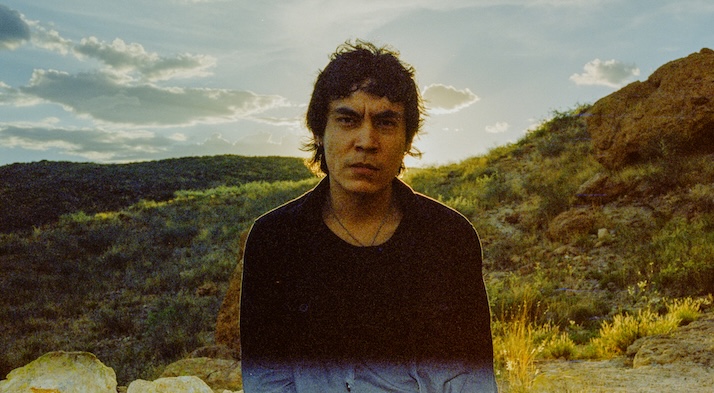 Photo by Daniel Patlán
I was in a taxi at 4am the first time I heard Ed Maverick's voice. Heading to Mexico City's airport, I clearly remember that despite the early hour and my own grogginess, there was something deeply raw and broken in the singer's voice that pushed me to ask the driver “What is this song called?” - “Mantra B”, he said. Now, nearly five years after that day, I got to sit down with Ed - one of Mexico's most emblematic indie folk artists - for an interview surrounding his fifth studio album Sin Agua es Ruta Yerma (Without Water it's a Dry Road) or SAERY for short.
SAERY is an album divided into two volumes, the first of which focuses on Ed's notorious existentialism, whilst the second is a collection of love songs which were dedicated to lovers or disappointments past. However, in spite of Ed's talent for poetic lyricism present in songs like “Tendria Que Hablar de Luz”, which is one of the songs he is most proud of to date - the album is not a conceptual one. Instead, the album represents a roughly seven year period of time where Ed dove headfirst into the world of music production and spent a great deal of time in near-isolation experimenting with sound. “It really is beautiful and precious to be in a studio with people you trust, doing it for fun. So in these years, that's been my focus: getting everything I can out of the production skills I've learned and having fun,” he tells me and adds that “I must have made like 60 instrumental experiments of songs … but only 20 made it into the final album.”
During our talk Ed and I kept coming back to how his instrumental and production skills have evolved since the start of his career. From his origins as a drummer, to self-learning guitar and bass, and now challenging himself to get out of his comfort zone via production. So, in order to better understand his headspace in the making of SAERY, I think it's worth it to do a bit of time traveling, especially if you don't know his story yet. In 2018 a then 17 year old Ed released his debut album “mix pa llorar en tu cuarto” (mix to cry in your room) - whose name may already give you an insight into its emotional contents. Included in the album was “Fuentes de Ortiz”, a now infamous song that has almost reached 1 billion streams and has been covered by some of Mexico's most well-known artists.
As his next two albums were released, his status as Mexico's go-to voice for indie melancholy only grew, but so did a mounting sense of fame and pressure, and because of it a pressing need to be alone and ruminate. In that context, he headed from Mexico City back to his hometown of Delicias, Chihuahua in the north of the country and set up the studio where SAERY and its predecessor La Nube en el Jardin were made - the very studio where he is calling me from, full of trinkets, posters and many “toys” (instruments) that he has accumulated through the years. “I also think that during the period when I was most shut in and isolated, making both albums, literally all my days were spent here, looking out the window”, he says as he points to the garden next to his studio space. “The environment truly dictates a bit how you're going to make the music. When I went to live in Mexico City, for example, it was very hard for me to get back into the rhythm of composing songs,” he adds.
Despite it not being the best place for him to write music, one habit that he brought back from Mexico City was a certain affinity for psychedelic drugs, a topic which he is rather open about. Although he has now left them behind, he describes how the psychedelic state, fused together with sources of inspiration such as 80s alt-rock music, created an environment where his usual calm indie sound could grow an edge, veering into pop, rock and even dark psychedelia. Experiences like watching The Exorcist for the first time or observing nature “actually led me to think about everything that exists in life, all of history, the bad trip that society is on right now. That feeling is what I think about when I think about the music I want to make and the message I want to give” he says.
SAERY may very well be his best and most mature album yet, but it also denotes the end of an era. An era that was spent exploring sound, starting his own label, learning to collaborate with others, and most importantly centering on his original goals for making music: an urge to romanticize life and achieve a state of calm through creation. After speaking with him, it is clear that the Ed I have in front of me is someone who will never stop ruminating and questioning life, but is also someone who is having fun and is more certain of his music than ever before. Whatever comes next will be the magnificent result of years spent tending to his not so metaphorical, musical garden, and I am sure it will be Ed in a way we have never heard him before.
This interview has been transcribed from Spanish and edited for length and clarity.
OnesToWatch: Hi Ed. How do you feel you've evolved as an artist and a musician since you released your first album 8 years ago?
Ed Maverick: Well, I think what always remains is romanticism. Ever since I started writing music, there's been a natural urge to romanticize life and to look for a state of calm through playing the guitar and writing songs, and I think that's something I'm still searching for. Where I have been evolving is in playing a bit with musical production, and that's what makes the project change and makes it more complete. What's been most noticeable in the project's evolution is the integration of new sounds that are directly referenced from the music I like nowadays.
Of course, and as time has gone by, you've been able to learn more about production.
Music production is very interesting, and you also step into a whole new threshold of things to pay attention to in songs. I'm here in my studio right now (shows me his studio) and I have a lot of nice toys [laughs]. In fact, I recorded both of my latest albums here (SAERY and La Nube en el Jardín). I'm still trying to expand upon the “calm” type of music I like to make, but also daring to explore, even if it's something people don't expect from me. So I'm making music I'd always wanted to make, but I didn't have the budget, the studio or the experience until now.
And on this album specifically, how did you challenge yourself to do something a bit different, or more adventurous as you'd always wanted to do?
Well, the first time you sit down to produce on a computer, it's a whole trip. In 2018 I was finally able to buy my first computer and an interface for my guitars, and that's how my first albums were recorded. Then in 2021 I made "Eduardo," which was the first time I could sketch out demos, go to a studio and say what I wanted to happen. For me the challenge has been more about understanding music production over these last 7 years, because producing is very different from going to a studio to be recorded. I've never fully felt convinced by how the music sounds when more people are involved. But that's also because I didn't know before how to express the needs I had when recording in the studio, and I didn't have the technical language to communicate assertively with the people I worked with.
And now you do?
I think so, but the challenge was learning to structure the songs. On a computer you have a kind of timeline, and you add your components along that timeline. When you do things with the guitar and a notebook, you build the whole structure in your mind, right? So I challenged myself to play with the resources I had and make interesting structures. There are a lot of songs on my album that I'd say are pop songs, because pop is, to a certain extent, the easiest thing for me to make given its classic structure. But as time went on, songs started to appear on the album that are more elaborate and don't have such a regular structure, like for example "Llagas."
You played almost all of the instrumentation, and wrote and sang the whole album yourself. Was it because you finally understood production better?
Yes. Even before I started my project, I played drums, bass and guitar. I've actually been a drummer since I was 12, and I taught myself the other instruments. I really thought, well, I already have all this, and if I learn to produce, I can create everything. Honestly, making music on a computer and producing it is a hell of a struggle at the beginning, but once you get the hang of it, it's total fun. Yesterday, for example, we were recording niño viejo, who is an artist from my label, and suddenly we were saying, "How beautiful is it to make music." It's funny, but it really is beautiful and precious to be in a studio with people you trust, doing it for fun. So in these years, that's been my focus: getting everything I can out of the production skills I've learned and having fun.
I've been looking at the visuals that come with the new album, made by Bonino, and I loved the photos because they have a very old-fashioned, desert quality. When you close your eyes and imagine the album, what do you see?
I see a lot of landscapes, stars, and sometimes I feel like I see it from inside a raindrop. When I made most of the songs, I was in the studio all the time and very isolated. Also, since returning to Delicias (his hometown in Chihuahua) from Mexico City, I kept up with an interest in psychedelic drugs, and that inspired me a lot. I've stopped now, but in that period I remember that everything I looked at had a glow around it, and geometric shapes were very present. I think that gave me a deep existentialism, where you realize that materiality doesn't matter and we're part of a world, part of a story.
I understand that feeling.
I don't know if this makes any sense, but I watched the movie "The Exorcist" for the first time then and with all its special effects, it was very striking to think about the beliefs people had before there was so much technology. I'm not religious, but I do believe in evil entities and all that, so watching the movie led me to think about everything that exists in life, all of history, the bad trip that society is on right now. That feeling is what I think about when I think about the music I want to make and the message I want to give.
Is there a lyric you're particularly proud of on this album?
Yes, all of the lyrics of "Tendría que Hablar de Luz" and "Llagas." Both come from a more complex place and from new chords for which I'm trying to find words. For me it was like, "Wow, I never thought I could do this." When I released my first album, my knowledge of guitar and music was very limited, and everything came more from the norteño music I used to listen to. Even on my second album, although I explored, I stayed in my comfort zone, with more folk or minimalist chords, like Bob Dylan. So, like I said, on this album it's been so nice to grow in terms of production and to create complex guitar parts with more than nine notes at once. It's really beautiful.
Of course, there are more possibilities.
As for the lyrics, as you can tell, I also really like to just talk [laughs] and I like finding the words to express what I feel.
You've mentioned that you had a huge number of songs created over this long period of time. How did you select the 20 songs for the album?
Over the last 7 years or so I spent my time experimenting with production and trying new things, going in directions I wanted to. I think this project goes back to 2022, and at one point I had more than 50 or 60 instrumental versions of songs, but I didn't have the inspiration to write lyrics for them for a while. In the end, even though the album has some songs that people might not expect from me, I chose these 20 songs because they're the ones that identify me the most and where I felt best listening to them and hearing how I sing them.
Of course.
There are a lot of the unreleased songs I don't love, because looking at them in retrospect, I'm always weighed down by the thought of "oh, I could have done this another way, this would sound better another way." for the final selection, I was also taking songs that inspire me into account, like "Total Eclipse of the Heart" by Bonnie Tyler, "Eye in the Sky" by Alan Parsons Project or "Running Up That Hill" by Kate Bush, those kinds of 80s songs that have a hell of an emotional weight and impeccable productions, which I think is my reference. They're bold, daring songs and catchy, but psychedelic.
You divided the album into two volumes. What themes unite each volume?
The first volume was about existentialism, having visions or hallucinations and realizations about life. And the second, in general, I think is a compilation of romantic songs, you know? Many songs were dedicated to someone at the time, either when I was falling in love or when I was going through disappointments. There was a lot of material to draw feelings from, and if I suddenly think a feeling has some potential, well, out it goes, right? Since this isn't a concept album, I also like for the listening experience to have coherence, and that gives me a lot of satisfaction.
Your previous album is literally called La Nube en el Jardín (The Cloud in the Garden), and you made it more or less alongside this new project. I feel like you use these garden and sun metaphors a lot, sometimes as if you were trapped inside watching the world outside, or sometimes as if you yourself were the garden. You've also mentioned that when taking drugs you'd forget to drink water, as if you were "the grass drying out." So I wanted to know what your relationship with nature is.
Your question makes a lot of sense, because I've realized that I've always lived on the outskirts or the periphery of the city. I have to say that here in Chihuahua the periphery is very different from Ciudad Juárez or Mexico City. Here in Chihuahua they're very close to nature, and I always found a sense of calm being close to it. When I came to this studio, my dream was to literally have a garden, I had to have grass and plants. So when I got to the studio and set it all up, the first thing I did was put in a garden.
I also think that during the period when I was most shut in and isolated, making both albums, literally all my days were spent here, looking out the window on this side. There's also a window that in winter ends up casting really beautiful colors during the sunset. And here, on this side (points), I have the garden. So I was playing the songs I was working on and looking out the window to see what the place and the garden told me. The environment truly dictates a bit how you're going to make the music. When I went to live in Mexico City, for example, it was very hard for me to get back into the rhythm of composing songs. So, as hippie as it may sound, I do feel the importance of nature in my life, because I think I have a connection with nature that's mental and energetic.
Especially since you have your own label “Hoy es un Buen Dia”, I always like to ask which emerging artists you've been listening to and what you'd like to share with us.
Right now I'm listening to a project from Jalapa, Veracruz, called César y su Jardín. It's folk jazz, very forest-like, very tropical, I don't know how to put it, but I love it. Also Edgar bajo el agua, who's on my label. I listened to him before he was on the label, and now that he's on the label I still listen to him - I'm a fan of all the artists on my label. Both artists are incredible to me. It's wild how digestible they are, but also very abstract in the way they make their music.
I'll have to listen to them. Thank you so much, Ed, and congratulations.
Thank you, Dany, for the space.
Listen to 'Sin Agua es Ruta Yerma' below: