
Owen Riegling, Look Where You Are Now! [Q&A]
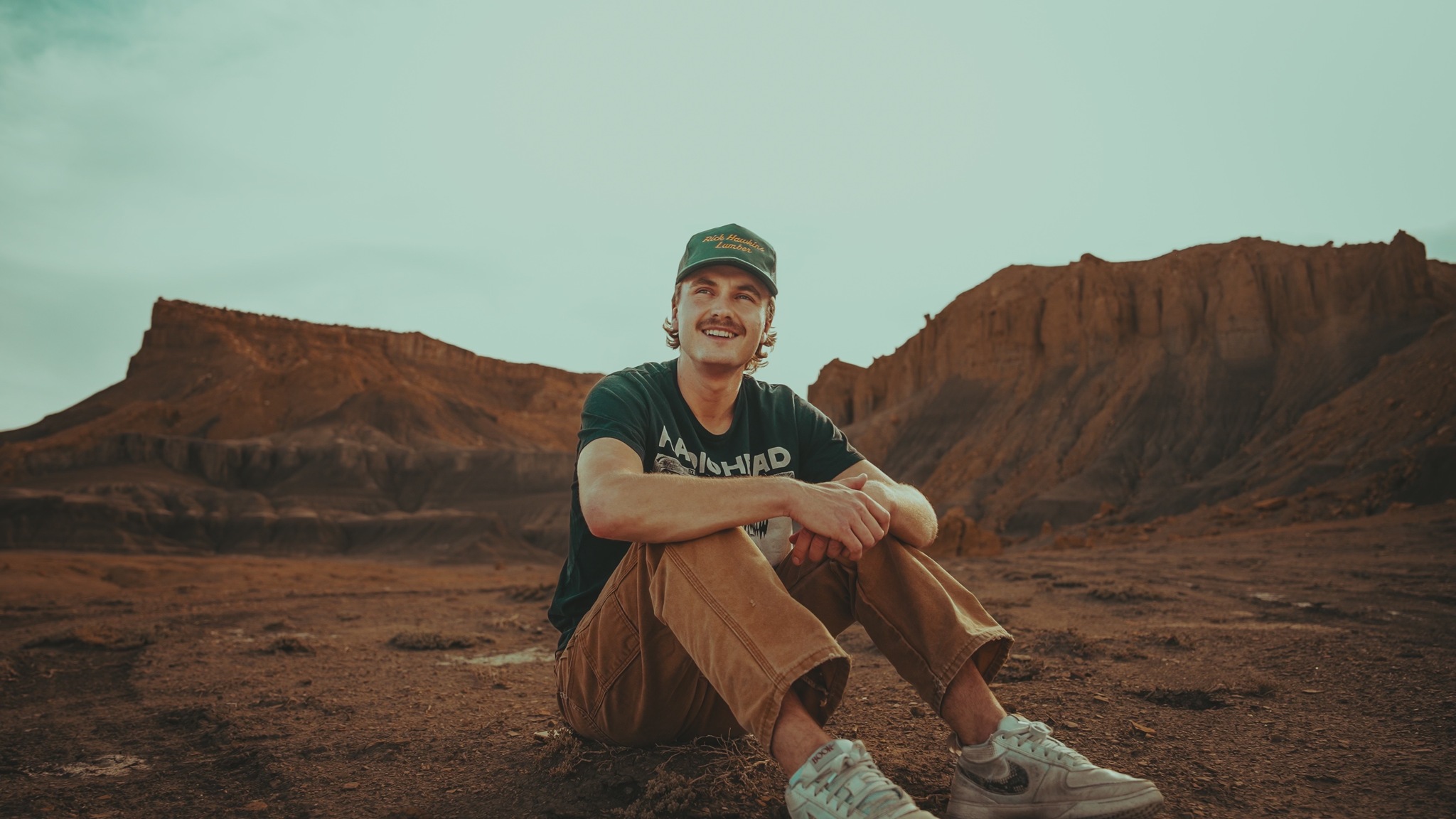
Photo by Connor Scheffler
I’ve been a fan of Mildmay, Ontario- born singer-songwriter Owen Riegling since I first stumbled on the storytellers dream that is “Dan,” a five-minute rollicking swamp-like country track off his debut EP Bruce County in 2024. “That’s SICK dude, I feel like that’s kind of a deep cut,” he said with a smile over Zoom. “I’ve been callin’ my fan club the ‘Dan Club’ trying to create a resurgence of Dan’s recently.” Though he is an evident disciple of his idol Eric Church, Riegling does red dirt country on his terms.
That EP would also include “Bud Light The Way,” “Moonshines,” and “Old Dirt Roads,” arguably his most well-known collection of contemporary country tunes thus far. He’d play over 100 shows that year, burning himself out in the process. “I wasn’t feeling very inspired, and I hadn’t written a song in a long time,” he confessed. At the behest of friend and collaborator Ryan Kennedy, Riegling sent a photo of his current location, a “stale airport terminal,” and received a multi-page word document in return with “nearly 100” song ideas based on his observations. This prompt rehabilitated Riegling’s desire to write and led to the development his new album In The Feeling.
Two years later, Riegling has refined his songwriting and actively works to improve and maintain his vocal technique. He recently made his Grand Ole Opry debut, cementing his place within the country music community. Despite the wins in both his personal and professional lives, In The Feeling sees Riegling stoically admit to many of his greatest insecurities and intrusive thoughts.
On “Mailbox,” he confesses to missing home, and the measures he takes to still hold on to pieces of it: “The funny thing my folks don’t know, I ain’t updated to my new PO/ My mail still gets sent to the door, just so I can go see em’ more.” The title track, which features Riegling’s most potent vocal performance of the project, narrows the concept of solace down to the desperation to find a forever home with his other half.
Elsewhere, songs like the Springsteen-inspired “Phone Call From Home,” current country radio darling “Taillight This Town,” the traditional media sync-bait that is “Love Hate Love,” and the career-defining closer “Anything But Me” stand out as highlights. “Anything But Me” is particularly potent, as it Riegling’s song of affirmation: “I was going nowhere, but look where I am now/ I wanted to be like you/ God knows that I tried to/ Do you know what you did for me? ‘Cause I do/ And, these days, I can’t imagine tryna be anything but me.”
During his sold-out hometown show at Toronto’s Massey Hall, fans collectively held up signs reading, “Look where you are now,” accompanied by a photo of a young Riegling with a guitar. A surreal moment for an artist whose skills have been apparent from the start, but can now confidently say he is where he is supposed to be.
OnesToWatch: “Weekend You” is the first song that seemed to point you in the direction you are now in. What do you think caused the shift to sort of ‘sentimental country’?
Owen Riegling: In trying to display this chapter of my life visually and sonically, I’m just trying to be as real as possible. The music that I just put out with In The Feeling is where I’m at right now. The emotions I’ve been dealing with, the chapters of my life and career I can look back on. Bruce County was the start of my career. It was me living at home, not knowing what I was in for, writing songs in my childhood bedroom. For In The Feeling, the cover art is me in the desert. I grew up in rural Ontario, SO far from any desert. I think that visually displays the discomfort, the newness, and how ‘out there’ I’ve been these few years.
What was the most striking aspect of that landscape that made you want to turn around?
I had a Pinterest board of all these things that reflected what I thought the music looked like, and I was pondering all the themes. It was clear that this has been a road trip era of my life, so we booked this road trip across America as the thesis of this record. Me, my wife, my videographer Connor Scheffler, and his girlfriend Mila, rented an RV in LA, and drove 2800 miles. We went to Joshua Tree, Vegas, Zion, Denver, all the way down through Texas, and ended up at a show in Mississippi with Billy Currington. We had a polaroid camera, and we’d capture these one-of-one moments from each place. We were driving through this desert, and there was nothin’. A no-man’s-land. Then, we saw that big sign, and drove past it. We thought we’d regret it if we didn’t turn around to it, because we made a pact that we were going to say yes to everything on this trip, so we went back and got that picture. It just LOOKED like the record. The sign said, “At the end of the world,” but Connor worked his magic and made it say, “In the feeling.” It reminds me of the road trip, of this time in my life.
You have been very smart about maneuvering your vocals from your early work until now. How early do you think you found the style that you feel is where you sit vocally?
It’s an ongoing process! I have a daily routine that I do twice a day. Through playing, my voice has gotten much better, and I have so much more control. When I started playing the bars, I had no idea how to sing at all. I went through many years, trial and error, and I hurt my voice. When that happened, I had to figure out how to not push anymore. How to really sing. After playing four hours a night, three nights a week, for six years, I really started to understand my vocals. That’s when I cut Bruce County. From that EP till now, I’ve learned so much. The music I make influences the melody and the way that I sing, because I’m inspired by certain melodies by certain artists. I can’t sing the highest, or the lowest, in the world, I’m just kind of right in the middle.
What is one aspect of Eric Church’s music or style you feel isn’t talked about enough?
He’s considered the GOAT… a true artist. He has had the success and played the stadiums. He’s not making the same song over and over because it works on radio. I don’t think he thinks about radio at all. The coolest thing about him is that he grows with his music and is evolving with every record. He treats his career like chapters as well, and that’s why I model myself like that. I want to grow and evolve these recordings, and make sure it feels like the first time I wrote a song, or picked up a guitar, every time I go into the studio. It’s about chasing the unknown, and I think Eric does a great job of that.
Does working with Tyler Hubbard [of Florida Georgia Line] in the capacity you have allowed you to view commerciality differently as far as songwriting goes?
I’ve always been a fan of FGL, so to be on the road with him and see the way the crowd reacts to those huge #1 songs is pretty cool. Obviously, everyone wants number one songs, so hopefully I can write one someday [Laughs].
He announced you would be making your Opry debut. What was that experience like?
I’ve always been a shy guy, so, through music, and playing big stages, I’ve come out of my shell. But, when I got to the Opry that morning, I had this growing pit in my stomach. The weight that that building has… so many legends, something I’ve been thinking about my whole life. Once it was over, it was time to celebrate. I was blanking on every line from the first song, but somehow, I didn’t mess it up. Hopefully we get invited back to play again.
For “Phone Call From Home,” do you go into the development wanting to chase the Springsteen Jersey rock sound, or do you land on that during the process?
When I wrote it, it had that ‘Springsteen thing,’ and I knew that. It’s got those xylophone bells in there. Oscar Charles and I were on the same wavelength with it. He could sense that feeling. People have picked up on that, which is really cool. It was a natural thing.
What are your top two Bruce songs?
I love “Thunder Road” so much because I saw Eric Church cover it a long, long time ago. I obviously love the original version, but Eric put new life into it. And, this is a cop out, but “Born To Run.” We play it in the live show. We put “Born To Run” in the middle of “Phone Call From Home.” It’s got that same energy… the driving drums, and tempo. It goes great with where I’m at in my life, because I’M on the run too.
What triggers you to start writing about the trademarks of your home life on a song like “Miles Away”?
I wrote that with Mark Holman and Jonathan Singleton. Those guys are hit machines. I was explaining to them where I was at, and we were talking about the chase… the dangling carrot in this business. When we found that turn on the hook; “The only thing connecting where we’ve been and where we’re heading to is we’re both miles away,” it made me think that I’m so far from where I started, but I’m so far from where I want to be. I’m in this weird foreign place.
Can you expand more on the chase? What do you feel the difficulties are for young artists seeking approval from the community and the fans?
It has been a long learning process. Aa a young artist – and I still consider myself a young artist, comparing yourself is super easy. Looking at other people’s success can be really bad, because they have it, but it’s something you want. That can be a motivator for some people to work really hard and focus on getting to the next thing. But now, I’ve had multiple things I’ve dreamed about happen to me. I’ve had songs do well, I’ve been able to tour with some of my favorite artists, I’ve played the Grand Ole Opry. You think that, when you hit the finish line, you’ll be like, ‘Wow, I’m the happiest person,’ but I don’t think the material thing will bring you the most happiness, and that’s important for young artists to know. The thing that brings you happiness, and that you need to be in love with, needs to be the creation of the music itself. The process of it. The set-up, the break down, going to merch after the show. Not sleeping, because you’re out doing what you love. If you can find happiness in all of that, I don’t think you can fail. That’s 99% of what this business is. It’s the things people don’t see.
Is there a science to writing a radio hit like “Taillight This Town”?
There definitely is, and Nashville is the best place on earth if you want to learn that science. There are so many writers, and they’ve written so many songs that they can see the ending of before they even start. When I started, it was just me and a guitar and I’d start with word one, line one. This stream of consciousness where each line informs the next, until I’ve reached the thought behind it all, and that thought is the title, and that’s the song. “In The Feeling” and “Same Blood” were written that way. We didn’t have the titles for “Same Blood” or “Mailbox” until the end. But then, with “Taillight This Town,” it was this very Nashville way of writing. You come in with titles and ideas in your phone. That’s the ending, now let’s figure out how to reverse engineer that. Punch up each line with lyrics that support it. That’s where radio hits usually lie. I’m not a guy to be askin’ about hits. I’ve never had a #1 song. I don’t know what that feels like, but I show up every day and I try to write the kind of song I’d want to sing onstage.
“I don’t know when I’ll get home, but I can’t exist on dreams alone” is one of my favorite lyrics of yours. How did you land on the word ‘exist’ in that phrase?
I don’t even really know! “In The Feeling” started as a conversation, written with my friend Ryan Kennedy. When we got together in the room, we wrote it in 40 minutes. It’s one of those magic songs you can’t think hard about. The thought of the word “exist” over “get by” or “survive” or whatever wasn’t even a consideration. We didn’t spend enough time to dissect each word, it just fell out, it felt good, and we knew that song would be the north star for this entire project.
Is “Anything But Me” the song you’ve been wanting, or trying, to write this entire time?
Totally! It takes courage to write songs that maybe don’t display you in the toughest light. I think country music is all about being tough, and I can’t even count how many times I’ve been in rooms where we’ve had to change a line because it’s not “tough enough.” I don’t consider myself to be this super tough dude drinking whiskey every night. I don’t relate to that as much as being vulnerable and being real at all times. It took me a long time to feel comfortable with that. I’ve written a lot of songs that have gotten me through a lot in my life, because you can always lean on the guitar, but that song needed to come out. It’s going to open doors for myself in the future to be able to write like that. It describes where I’m at right now. For a long time, I had no clue what I was doing. Didn’t love school, I didn’t excel at sports. I wasn’t the worst, but I didn’t have “that thing” that I thought everyone else had. Through music, I haven’t had to ask myself, “What is MY thing.” That’s when the epiphany happened. I haven’t asked myself that question in a long time, and it’s because of this journey I’m on. I have such a tunnel vision on music. I found this thing that lights my fire and makes me happy. I wrote it with Connie Harrington in one session. My first time swearing in a song, but it needed that emotion.
Did any of the topics you talk about on this project feel unattainable at a certain point? And if so, do they make sense now that you’re able to write and release these songs and see how the fans react?
Yeah, I think so. “Anything But Me” has an ending. For most of my life, it was just the first verse and chorus of me not knowing. It took everything up to this point to have the realization that I’m here now, and it’s going to be ok. I have music to lean on. Putting this album into the world, and receiving the feedback I’ve gotten is proof that there are people out there that feel the same exact thing. There should be somebody to talk about those things on a bigger scale, so that people don’t feel as trapped. It’s ok to not know, but once you find the thing, that’s when you go all in. Let it take you where it takes you, because I think that has the power to take you out of that feeling.
Listen to In The Feeling below:
![The First Hard of Hearing K-pop Group Big Ocean Want to Be Known As Singers With Sexy Hands [Q&A]](https://s3-us-west-2.amazonaws.com/onestowatch-v2/d_s_c00867-1792271744.jpg)
![Oscar Lindsey Chats Blissfully Melancholic New Album 'Sunshine' [Q&A]](https://s3-us-west-2.amazonaws.com/onestowatch-v2/unnamed3.32.38_p_m-1792190335.png)
![Andrea Bejar Is More Honest Than Ever With "In Bloom" [Q&A]](https://s3-us-west-2.amazonaws.com/onestowatch-v2/andreamexico-129-_k_c_r_w_e_x_c-1792006260.jpg)