
youbet's Self-Titled Album Is A Mosaic of Life [Q&A]
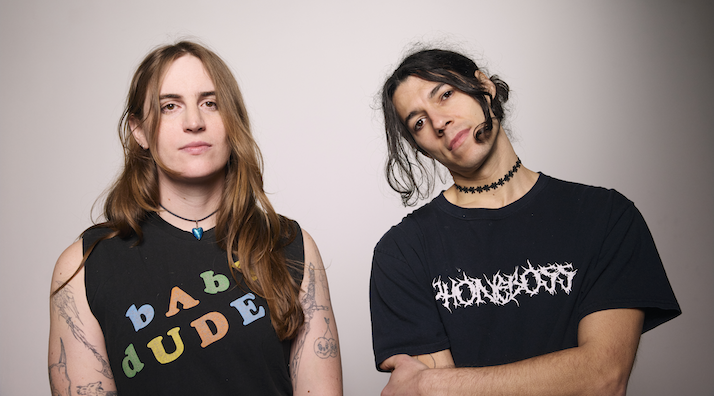
Photo by Eleanor Petry
A staple of the Brooklyn indie scene, duo youbet has released their magnum opus (thus far), suitably named after the band itself. Born of stream of consciousness lyric writing, the self-titled album is a true reflection of principal songwriter Nick Llobet’s psyche–bridging the expanse of themes like fervent possibility and the dissolution of a decade-long relationship. Now evolving into a duo, the eponymous album also acts as a kaleidoscope of Micah Prussack’s arranging prowess. It’s an expansive level-up for the band, drawing on influences like Big Thief, flamenco picking patterns, Chopin, and even so-called elf music. Needing to hear more from the duo themselves, we called youbet from their pre-show outdoor time in Reno. Read on for the wisdom:
OnesToWatch: Where do I find you two?
Micah: We’re in Reno. It's the new LA. We’re playing rock music tonight.
Right, of course. Well I shan’t keep you from your rock music. For our first question, I'd love to know… who is youbet?
Nick: Well, I'm Nick. I started youbet in the year 2018, I'd say. It was a vehicle for my songwriting style, and it's just grown into a bit of a family. I've played with a lot of different people over the years, and just now in the last few years, it's kind of culminated into more of a fixture. We have a more concrete team than has existed in eras of youbet past.
As this is newly a collaboration between multiple people, what would you say each of you bring to youbet? Is one person more responsible for lyrics or sounds, or is it an equal culmination of your minds?
Nick: I write all the songs in terms of the lyrics, chords, and melody. We're more of a collaborative band where I bring the song to the practice.
Micah: And then I do a lot of arranging. I can communicate very well with drummers.
It's a hard skill.
Micah: That is true. So if you think about the totally elemental components of a song –it's basically lyrics and a melody and chords– that’s what Nick cranks out. Nick has a great batting average for doing that. Then I go over to Nick's house and we listen through the demos and we talk about them and I say, “I’m hearing this on this song, we should develop this one further, I don't know about this song, but I really like the bridge, let's steal that for something else, etc.” So we hack and slash elemental components and turn that into something that is refined and ready for either a live performance or a recording.
I love that. It seems like you, Micah, are the translator for Nick’s songwriter chaos.
Micah: The way that we have discussed this in past interviews or just amongst ourselves, is that Nick is in the artist's mentality and I play more of a facilitator role. I'm good at seeing things through. We also have our manager Veronica, who's on the other side of the spectrum of artistry where she's worrying about stuff that is impossible for us to keep track of ourselves. Ian, Nick, and Veronica have been working together for years.
Nick: Over three years now.
Micah: Four years ago, this month I met Nick.
What makes this the self-titled youbet album? I feel like that's usually the first album, but this is your third.
Nick: To be honest with you, I could not think of a title for the album. But also, we were thinking of titles going in, and for a long time, we felt like self-titled would be a good idea for this one. It felt like we were stepping things up. A lot had changed for us from the past albums to the creation of this one. We became a touring act. We had toured the U.S. and Canada a ton. So it really felt that perhaps a reintroduction was in order to some degree. If this album was going to make some sort of splash or reach a wider audience, we felt–not to discredit any of the work on the past albums, because I think they're great–this one definitely feels more high definition. We felt confident.
I love that. Did the amount of touring that y'all were doing, did that affect the process of writing this album? Were you thinking more about the live performance too?
Micah: Certainly. In the past when youbet was not touring, we had performed live just in New York as a five or six piece, grabbing lots of friends to come and plug in their sounds to all the layers that were on the recordings. But when it came time for us to tour after A Way to Be came out, we had to rearrange all those songs for a trio. So then all the next batch of songs that we worked on were immediately arranged for trio, which was a really different vibe. The process of then creating the album was turning the trio arrangements that already existed into full-fledged recordings.
That makes sense, so you almost worked backwards. At what point did you decide that this was an album that you were writing and not just all of a sudden we're putting the songs together? Or did you at all decide?
Nick: I'm always writing, constantly.
Micah: You're always writing.
Nick: I'm always making song demos and not all those demos make it to an album, but I'm always planning on there being an album at some point. So as I'm writing, I'm collecting the songs that I feel strongest about. Usually the ones that we play live as a band end up being developed further into an album. Some end up being developed into the garbage. Going into this album session, in my head, we had 16 songs floating in the world of unrecorded material. That became 10 for the finished product.
That's a pretty severe cutdown.
Nick: It happens. Hearts get broken.
Micah: My heart was broken.
Nick: Yeah… I'll just cut a song if it isn't vibing. I put out music I hate before andI had to live with it for life. Once it's on the internet, it's out there and people are constantly reminding you of it. I've been traumatized by putting out stuff I'm unsure of, so I'm very, very okay with cutting songs. But that really offends people in the party, unfortunately.
[Micah nods]
Nick: But for me, the way I look at it, is that it’s so important to put out things you're excited about. And if you're not sure, write another song you like and don't worry about it. I'm not precious with certain things.
I think that's good advice. A lot of people would say the contrary, which is to put the song out because of the work you put into it.
Nick: Everyone's different. My view is, there's nothing wrong with trying again and doing it right. But people are entitled to putting out crappy things. I'm kidding.
So true. Were there any themes that presented themselves as you were collecting these 16 and then 10 songs? Any throughlines?
Nick: Throughline is hard because I write from a stream of consciousness lyrical perspective. I rarely write about specific events in my life, although some of the songs on the album are about real things. As far as themes go though, what I tell everyone is that the youbet formula, emotionally, is balancing humor, beauty, and darkness. I'm just trying to see if I can be provocative with balancing those things, seeing if I can grab people's attention with one of those and then take them on a little bit of an adventure with it. I was in a 13-year relationship that ended when I started writing these songs. There's some of that in there. I guess our new friendship is in there too, the magic of Micah and I.
I enjoy when people aren't writing from a concept album standpoint, because then you can truly see what was going in your mind during the time of writing. And there always is a through line.
Micah: It's just the impressionistic standpoint. In the aggregate, it will always have been about something, but it doesn't have to be hitting you over the head with it.
Oh, write that down. That was good.
Nick: You have bars today.
Micah: My brain is just bulging out of my ears today.
It's the Reno of it all.
Micah: Now that I live here, it's like I'm at home, you know.
When I was reading about the album, I was immediately struck by the influences you cited. You mentioned the scores of Alfred Hitchcock and flamenco music. I would love to hear about that, but also if there were any other sonic north stars for this album.
Nick: Flamenco was something I got into during the pandemic. I really started to listen to it and study it and try to learn it on my guitar. The harmony of flamenco, the chord progressions, they always seep their way into my writing, just because they're so different and so exciting and dark and mesmerizing. There's this magic feeling I get when I'm writing the chord structure from flamenco into my songs. And Alfred Hitchcock, it’s mainly just the Vertigo soundtrack, which made its way into one song. I stole the chord progression for this one song from the track. Other influences… we were listening to some Autolux for some more high energy stuff.
Micah: We listened to a lot of music together on tour. We started by listening to a lot of great trios because that's what we were recording as. Boris is another big one. NOMEANSNO is a trio, an uber punk, post-hardcore band. I mean, we just listen to so much stuff. We love Ovlov. Now we're listening to video game soundtracks. We were really stressed driving home one tour because of extraneous circumstances and we just listened to swans the whole drive home. A lot of classical music, too, Chopin. There’s this album by Skulí, which is literally elf music.
Nick: Oh, it’s so good. It’s elf music.
Micah: It’s also like mouse detectives, a little bit at parts. It’s the perfect soundtrack for driving through somewhere beautiful. Our listening habits are really all over the place. We like things that are putrid and heavy and disgusting and vile, and we love things that are just the pinnacle of beauty. We're listening to some choral arrangements, the Lord of the Rings soundtrack. What is so great about our working relationship is that we just glean so much from anything. We can appreciate things for what they are from an artistic standpoint and derive so much enjoyment out of listening to something happen.
Nick: To make great songs, not that I make great songs or we make great songs, but I think in my philosophy, to be connected to what you do, you have to be able to find something beautiful in everything. For example, we were talking about Green Day, I don't like Green Day. It's not a band that influenced me in any way. But I appreciate the hell out of Green Day because they write such perfect songs: very good melodies, very good lyrics, very good guitar solos, very good arrangements. All the players of the band have their own voice. I don't listen to them, I don't derive any influence from them. But I love the ability to stand back and objectively hear all the things that I really respect about them. Having that kind of outlook is the youbet vibe.
It's lovely to hear about your range in influences, because when you listen to the album, it captures that. In the nicest way possible, the putrid is so there, but it’s right next to a really delicate, flamenco-esque guitar picking pattern existing at the same time. On the production side, I’d love to know if you had any pieces of gear– plugins or pedals or synth, anything– that you kept turning back to while you were making this album.
Nick: Yeah, I have a plugin. The Mishby Tape Abomination Plugin by Freakshow Industries. It's pay what you can. You could pay $5 or more or less. It's a very, very, very clutch plugin for me. I don't really use plugins that much, but that's one I do. It's a tape emulator, but it does a lot of other weird shit. It's a freaky, morbid plug-in. If you look at it, it's got like all these really weird tentacles and you turn a knob and it’s like a funhouse kind of thing. It's really weird, but it sounds crazy, and I love automating it. It’s especially in “Ground Kiss.”
Micah: Every single song on the album, I use my P-bass with flatwounds. I don't always play that one on tour, but that is the bass that I used on every single song because it's just the best sounding bass in the universe. And I hate saying that information for free because Fender won't sponsor us.
But you know what? Not yet. I'm going to call Fender right now. I have three final, fun questions. I would love to know if this album were a candle, what would it smell like?
Micah: How about some flowers, like the album cover? Nice flowery scent. But not a nauseating Yankee candle vibe.
Nick: More like putrid.
I'd also love to know what your favorite sound is right now, but like a life sound, not a music sound.
Micah: That's a good one.
Nick: Any time someone's like, “Your food's ready.”
Micah: The rev of a hot engine. A Dodge Charger.
My final question then, is who your OnesToWatch are. You've already given me a lot of great recs, but any friends, up-and-coming artists you can recommend?
Micah: Marblemouth. Or Best Offer.
Nick: Some Brooklyn artists that we love are our friends Raavi. We really like this band Cohort B.
Micah: We saw them in some basement. It was one of the best shows I've seen.
Nick: Lip Critic is already having a moment. They exist in that world a little bit, but they're more hardcore as opposed to Death Grips. Clifford, the band from Boston.
Micah: Our keyboard player, Jolie, has a project called Jgo. Hound's Teeth. I have to report that the Brooklyn scene is like, so back.
Ooh, that's great news. These are all great. All the best shows are seen in a basement.
Micah: So true.
Thank you both so much.
youbet: Thank you!
![Moody Joody Draw Us Closer to their Debut EP, Plain Jane [Q&A]](https://s3-us-west-2.amazonaws.com/onestowatch-v2/unnamed-1791228468.jpg)
![Weston Estate Grows Up and Into Debut Album, 'Open Season' [Q&A]](https://s3-us-west-2.amazonaws.com/onestowatch-v2/i_m_g_8944_copy-1791395273.jpg)
![LIA LIA Infuses Nostalgia for an Unknown Memory into Album, Armor [Q&A]](https://s3-us-west-2.amazonaws.com/onestowatch-v2/l_i_a_l_i_a1-1791234524.jpg)