ATARASHII GAKKO! Talk Grabbing Hearts and Sharing Love from Tokyo [Q&A]
Photos by David Dickenson
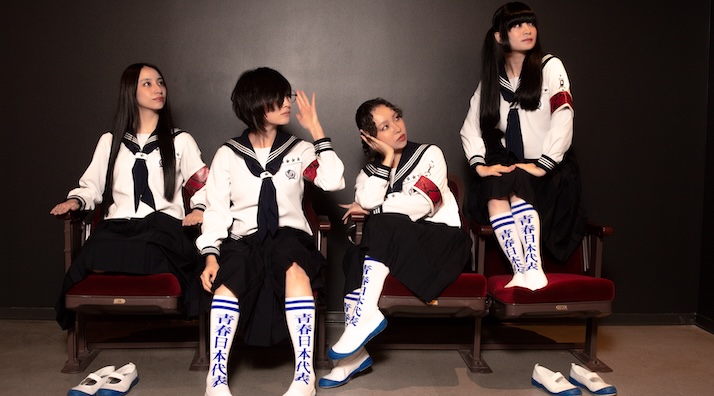
Wearing their iconic sailor fuku, red armbands associated with leadership in Japanese schools, and socks that read “Seishun Nihon Daihyou” (or “Youth Representatives of Japan”), ATARASHII GAKKO! was full of energy when they joined us in Los Angeles following their festival performance at Bumbershoot in Seattle. ATARASHII GAKKO! (also known as AG and Atarashii Gakkou No Leaders, or “Leaders of the New School”) formed in 2015, making their Japanese debut as a group in 2017, and worldwide debut in 2021 with 88rising. Initially created with the philosophy of challenging the norms of Japanese society in mind, the group has always strived to embrace individuality and freedom, acting as representatives of Japanese youth defying those norms.
ATARASHII GAKKO! first made waves with their viral hit “OTONABLUE,” which showcased their powerful vocals and mesmerizing dancing, but the group’s passion and confidence is what really resonated with audiences. With a swag that’s unique to ATARASHII GAKKO!, their high-energy songs are further amplified by out-of-this-world choreography that the members create themselves, making their performances nothing short of electrifying. Through a mix of Japanese and English, we chatted with members SUZUKA, MIZYU, KANON, and RIN in Los Angeles about their upcoming plans, live performances versus solo concerts, and their most recent album, From Tokyo with Love.
OnesToWatch: You are about to embark on your First Latin America Tour this winter, hitting Chile, Brazil, and Mexico. What are you looking forward to and what do you want to do when you’re there?
Suzuka: I'd like to try out Brazilian samba when I'm in Brazil.
Are you looking forward to meeting your fans there?
Suzuka: I can't even imagine what the audience will be like in Chile and Brazil. The audience in Mexico was quite the crazy audience, so I’m excited to see what kind of energy Chile and Brazil bring.
Mizyu: For our 10th anniversary, we had our movie, Go Wild, come out, and they had a showing in Latin America as well. When that happened, there were probably about 30 AG! fans that showed up in Chile wearing our costumes and our merch. We saw a photo of that, and that left such a good impression. I'm looking forward to meeting all of them.
You just released your fifth album From Tokyo with Love in July. What was it like creating this album, especially creating the solo songs for Rin, Kanon, and Mizyu?
Rin: We started creating this album at the beginning of 2026, and like the title From Tokyo with Love suggests, we took a look at what it means to actually create an album in Tokyo, and to share the message of love from Tokyo to the world globally. This is the first time there's solo songs for us—Kanon, Rin, and Mizyu—and it's an opportunity for us to showcase our individual personalities, but there were also moments where we worked on it together. For me personally, I wrote my own lyrics, so it gave me an opportunity to look more at my inner self.
Kanon: For my song in particular, our producer Yoshio Tamamura just kind of made the song and played around with it. But when I listened to it, I felt like it matched me well, and at the end of the day, he does know me well. I enjoyed it, and we went on with the recording process at a pretty early stage.
Mizyu: I wrote my song, “Kore de E,” together with the earlier mentioned Yoshio Tamamura as well as another producer, yonkey. It combines words that I wrote myself, as well as the idea of how the people close to me see me. When we were making this album, the focus wasn't solely on recording; we were busy performing live and were also on music shows. I think this song reflects the idea of finding my inner self within my busy schedule and busy life.
From your iconic school outfits to references to Tokyo in your music, Japanese culture and music has always been central to your concept as a group. In a time where global music may have more similarities than differences, why was it important to you to continue to keep these influences at the forefront of your artistry?
Rin: There might be aspects where we do end up focusing on Japanese culture in a sense, but we're not purposely or intentionally focusing on that “Japanese-ness.” I think part of it is that all four of us are born and raised in Japan, so it ends up being that Japanese culture just happens to kind of come out when we perform. Of course, at the end of the day, we are influenced by culture outside of Japan, whether it be through music and whatnot… maybe Western music. But I think whether it be through our outfits or our performances, bits of Japanese culture are at our base.
Since your debut, your philosophy has been challenging the norms of Japanese society, acting as representatives of Japanese youth that represent individuality and freedom. This mindset can truly be seen in your performances and your art. Do you still feel the pressure of challenging those norms, and how do you think your position has changed, if at all?
Kanon: I feel like that pressure to challenge the norms and to go outside of the box, we had it more before rather than now. Back then, we had to respond and answer to our own expectations, whereas now I feel like we've blended naturally into those expectations. We don't have to actively respond to those expectations [of] if we are representing individuality and freedom. Rather, we just think it's not fun and it's a bit boring if we're just doing everyday ideas. We're just naturally thinking about those ideas rather than responding to the norms directly, so it feels like there is less pressure in that sense.

How has your creative process evolved over the years, and what has remained the same?
Suzuka: First step: listen to music. Second step: Meeting, thinking. [points to the rest of the members] Mizyu, Suzuka, Rin, Kanon—homework. Together, session, done.
Your live performances are always larger than life and show audiences a different creative side of ATARASHII GAKKO!, including your dynamic and energetic choreography. Between ATARASHII GAKKO! concerts and festival sets, how do you prepare for both performances?
Kanon: Even in terms of the mindset, it's so different, how we approach festivals versus solo shows. For festivals, we're approaching a new audience that might not know us, and there’s also the difference between overseas festivals versus Japanese festivals. But regardless, what's important is the speed aspect—how fast can we grab new hearts? Whereas solo concerts where it's just us, the fans are there to watch us. I guess in a sense, we focus on the production value of what they can gain from the concert, and we put value in something they can only watch because it's a solo show.
Which do you like more?
Rin: It's hard to choose, both of them have their great parts. Like Kanon mentioned a little bit, festivals are a challenge because it's a little bit of a hunt to grab the audience’s hearts versus solo shows feel more like home. But at the same time, there's that difference between overseas solo shows and Japanese solo shows. Overseas shows can still be a little bit of a challenge, versus Japanese solo shows kind of feel more like, “Oh, we're back home with our family members.”
You signed with 88rising in 2021 and have since been more active in promoting outside of Japan. What does it mean to you to be part of the wave of Japanese music and J-pop becoming more recognized globally?
Suzuka: Even though [the songs are] in Japanese, it's nice as long as [listeners] can feel the vibes with the music and energy. It's also nice if they can translate the lyrics—and with our unique melody—feel a sense of “Japanese-ness” where they feel like it’s something different from what they usually listen to. It's nice that we can be a part of that and represent Japan.
Who are your OnesToWatch?
Suzuka: TV TAIRIKU ONDO, we met them in Taipei [at JAM JAM ASIA]. They are so young, 19-20 years old. [They’re a] local punk band in Hokkaido, they have such homemade vibes. Now, entertainment is so scaled up and big and so cool and beautiful, but they are so humble. I think maybe TV Tairiku Ondo is on the rise, and ATARASHII GAKKO! is on the rise too!
Rin: ATARASHII GAKKO! is coming! But, Amie Blu. She randomly showed up on my Instagram feed, and that captured my attention. I've always liked hip-hop and R&B, so that got me intrigued, and recently I've been really interested in her music.
Mizyu: ATARASHII GAKKO! They're so positive and all of them are full of such lively souls. I think they've changed my life, and I think they can take over the world, take over the entire galaxy, and I hope to be a part of that momentum. But in all seriousness, I'm not so good with getting to know new artists and finding out about new artists. I usually listen to older artists, so if I can learn who the up-and-coming artists are, that'd be great.
Kanon: Cameron Diaz [all laugh]. Cameron Diaz, same vibes, same name vibes. But, ATARASHII GAKKO!
Listen to From Tokyo with Love below:
![Sofia Camara Shares What She’s Learned On New EP ‘Still Somewhere Here’ [Q+A]](https://s3-us-west-2.amazonaws.com/onestowatch-v2/main_press_photo(credit__andré_tentugal)-1792182185.jpg)
![wakelee Are Learning to Live With the Unfinished Parts of Themselves [Q&A] | THE NOISE](https://s3-us-west-2.amazonaws.com/onestowatch-v2/unnamed-1792091490.jpg)