Chuwi Is Building a Vision of Freedom With Their Debut Album, Libertad [Q&A]
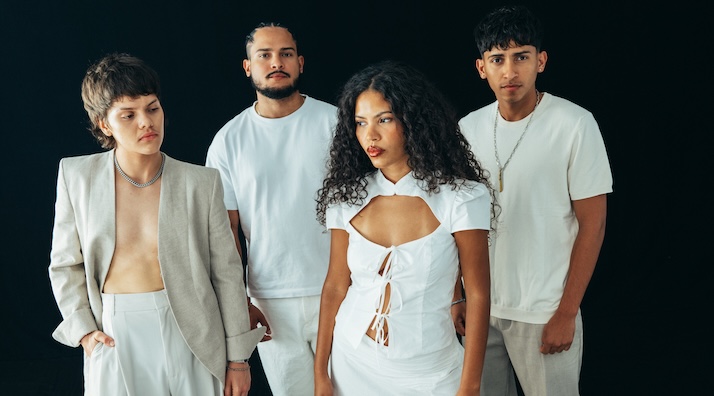
Photo by Eric Rojas
Identity, belonging and the pursuit of freedom are at the core of Chuwi’s debut album, Libertad. The project explores the political realities and struggles facing Puerto Rico, reflecting on what freedom means for the island and its people. Chuwi is a quartet from Puerto Rico consisting of siblings Lorén, Willy, and Wester Aldarondo, alongside their family friend Adrián López.
The project moves through Danzón, Cha-Cha, Punto and more, with each song woven into timeless genres and lyricism. You don’t just hear it, you feel it, and you come away with stories of what Puerto Rican life is really like. The selection of featured artists were also intentional, including Wampi and Daymé Arocena who are both Cuban and Puerto Rican cuatrista José Santana.
You may have already heard Chuwi without realizing it. If you listened to Bad Bunny’s Grammy-winning album Debí Tirar Más Fotos, you caught them on “WELTiTA.” They also performed at Bad Bunny’s residency in Puerto Rico and toured Europe with him. And if you’re a Tiny Desk fan, you might remember their own set from last year, released during Latino Heritage Month.
OnesToWatch spoke with Chuwi about the process of working on their new album, touring and the meaning behind the music.
OnesToWatch: Libertad is your debut album and the final chapter of the Pan, Tierra, Libertad trilogy. Looking back at all three projects, how do you feel you’ve grown as artists?
Loren: We consider ourselves still young artists, but on the scale of “young,” Libertad comes at a time when we feel more confident in the type of music we’re making. With our earlier EPs, Pan and Tierra, we loved the sound, but it was very intuitive, because we didn’t have anything to compare it to. It’s either very Caribbean, like Juan Luis Guerra, whom we love, but it is what it is, or it’s like Fred again.. doing weird sounds in his DJ set. The fusion of the two isn’t something we feel we can compare to anything. So with the first two EPs, it was very much, “Will people understand it? Are we being too weird?” But at the same time, we loved what we were doing, so whatever. It was that same combination with Libertad: we love what we did, and now we know, with experience, that some people will understand it, and that’s completely fine, because we’re happy with it.
The album follows an emotional journey from questioning and anger to courage, action, and hope. How did you approach sequencing the tracklist to tell that story?
Adrián: It was honestly something that came out very organically in the end. It was already a project we'd been working on, here and there, for the past couple of years, but when we actually took all of the pieces and put them together, we noticed that they made the perfect puzzle. There was definitely intention behind the songs individually, but the end product turned out to have such a perfect beginning and end.
Libertad incorporates a range of Caribbean rhythms, including timba, danzón, and cha-cha. What was the creative process like when deciding which sounds and rhythms best represented each song?
Willy: We have an instrumental storyline running through the last three projects, including this one. For example, with our first EP, Pan, we wanted to try writing in popular Puerto Rican genres like bomba and salsa, and then for the second EP, we tried Dominican genres. So for this one, the goal was definitely to look into Cuban genres, and Cuba has by far the largest number of genres. Even by region, there can be many. It really channels the creative process, because you have something to start with, and it's also exciting to discover a genre, look into it, try to understand it, talk with people about it, and learn how the rhythms work. Each genre has its own approach to songwriting too, in terms of how to structure songs. So just by deciding to write in a genre, you get this whole system that comes with it, which really helps you write songs and frees you up. Since you already have the structure, you're free to experiment and try new things. You're not starting completely from scratch, and at the same time, it feels good to pay homage to these genres and to work with genres that are basically from your home, from your people, that not everyone else is doing.
You collaborated with Wampi on “Fantasmeo” and Daymé Arocena on “Veo Veo.” How did you decide on these collaborations, and what was it like working with them?
Wester: For Wampi, it was very interesting because we were in Madrid at the time, touring, and by chance he was also touring in Madrid at the same time. When we saw that coincidence, we were like, "We have to link up and try to work on this song together," and it managed to happen. We literally met up one day and worked on the song for three or four hours. He did his part on the spot, super fast, and we finished the song. So that was amazing.
With Dayme, it was also very interesting because, as you said, she's like a goddess, but she's also very knowledgeable about Cuban rhythms, history, and culture. She educated us a lot about the context of these rhythms, what they mean religiously and what they mean culturally. So it was both an artistically satisfying experience and a very nurturing one in terms of knowledge.
“Máquina” is the album’s focus track. What made you choose this song to spotlight, and what was the creative process behind it?
Willy: "Máquina" means, as the name implies, "machine," and the theme behind the song references a machine that has spun out of control. It has disconnected its own power switch, so it can't be turned off. We wanted the music to represent that too. We wanted the instrumentals to feel like an out-of-control machine with many moving parts. That was the approach.
Once we started implementing it, we realized the big mistake we had made in trying to build a song with so many instruments in such a complicated genre. It's Timba-inspired, and as far as I know, there's no more involved genre than Timba in terms of the instrumentation, the skill of the musicians, the variation, and the dynamism. We attempted that. It was kind of painful, but very rewarding in the end, because we came up with something listenable and danceable that also gets the message across. So it was by far the most challenging song to make on the album. Now that we're rehearsing the songs, it's also the hardest to perform, but the most rewarding. It makes us feel like we stepped it up in every sense, musically and artistically.
It made sense to choose it as the focus track. I think it's a good sampler of our sound, and it showcases everything that makes us Chuwi, like Loren's crazy vocals there too.
When she sings, I feel it. I’m like whoa are you talking to me? Like, you're talking to the people.
Loren: You have no idea, that song stole my soul. It was such a challenge, but in a good way. Thank you for saying that.
Touring internationally showed you that many struggles affecting Puerto Rico, from displacement to the rising cost of living, are shared across the Caribbean and beyond. Was there a particular moment on the road when that connection really hit you?
Loren: It’s a sad topic because, sadly, it’s not just one place. To your point, it’s everywhere. We had the privilege of presenting our music at the opening of the Debí Tirar Más Fotos concerts, and in every country we went to, we would get DMs, direct messages, about several songs. The song that was referenced most was “Tierra.” People would talk to us about their struggles with the cost of rent, having to move, or the places where they were raised becoming more gentrified. It’s a global situation where I feel like the middle class is being pushed to the outskirts, to the less developed parts of countries. So I don’t think we could tell you just one story. I think there would be so many. But off the top of my head, we were in Germany, and we would put up subtitles in the language of each country. There was this person who was Greek, so German wasn’t even her first language. It was her second. Our mom would sometimes be able to come to the concerts, and she was in the pit area. My mom and I look alike, so a lot of people would ask, “That’s your daughter, right? Those are your kids?” Well, this particular woman was crying. She said, “I understand what they’re saying. I moved from my country here for a better opportunity.” It made her miss her land. We wrote that song in our parents’ living room, so to think that a Greek woman in Germany, reading German lyrics, would connect with the sentiments
With Libertad, you move from exploring the realities you want to change toward imagining the future you want to build. What does freedom look like to Chuwi today?
Willy: That’s where the concept comes from. Part of what we want to express in the song is a response to all the struggle and all the mourning that we explored in our previous work. Once we process this, what do we actually want to see? What’s the goal? Right now, that’s where we are: what is freedom for us today? Freedom is still a project that we have to build on our own. It’s something we need to decide what it’s going to look like, something we need to envision and start working on today. And we have the hope that in our lifetime, or in our generation, we’ll see that project fulfilled. That’s kind of what the song “Libertad” tries to encompass: that vision.
What comes next for Chuwi? What else do you have in the works?
Wester: We're ready to share the music with the rest of the world. We're ready for people to hear it first, and then we're planning to do a couple of shows in a few places. Nothing is confirmed right now, but that's the idea for now.
Listen to Libertad below:
-1792093205.png)
![Andrea Bejar Is More Honest Than Ever With "In Bloom" [Q&A]](https://s3-us-west-2.amazonaws.com/onestowatch-v2/andreamexico-129-_k_c_r_w_e_x_c-1792006260.jpg)