
Gabriela Richardson Chats “ISOLA”: Tangled Roots, Traditional Influences, and Debut Album Grief [Q&A]
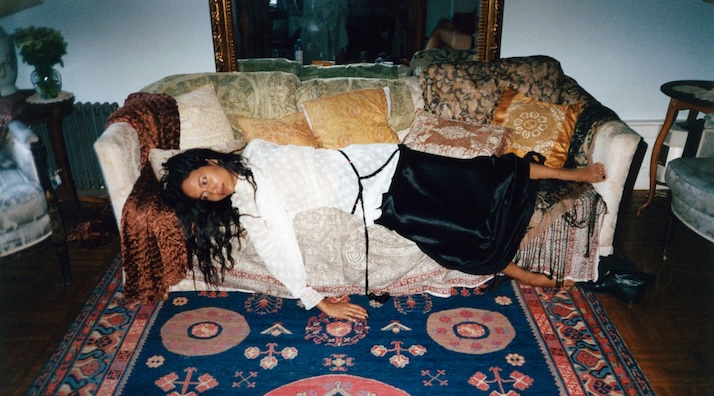
Photo by Ana Larruy
An amalgamation of varying identities expressing themselves through one sacred vessel, Gabriela Richardson finds womanhood in the meeting of her polarities. Black and Spanish, neither one more than the other, the identity one longs to uncover is always found in the return home.
Her debut album ISOLA journeys through Spanish, Italian, English and French to celebrate an unconfined liberation. She’s found herself in the full embrace of all that she is, and this project poetically tells that very story through an immersive sonic landscape that samples ‘70s Brazilian funk and Latin folk.
OnesToWatch got a chance to sit down with the songstress following the album’s release to discuss tending to her tangled roots, her traditional musical influences, and the grief that accompanies releasing a debut album.
OnesToWatch: Your roots are so spread out, it feels like you’re a mosaic of so many different cultures. How do you define home?
Gabriela Richardson: This is actually a very good question because when I think about home, or when I think about a place that made me feel myself the most, I would say the island of Ibiza. That’s where my where my father immigrated from Mississippi in the ‘70s. He was one of the first African-American men to arrive to the island and build a house there and create his community and make art in the island and feel free without judgment. There's where he met my mother, she used to go there every summer. She's Spanish from Barcelona. They had this love and they made me there. So every time I go to Ibiza, even though now it changed a lot, it maintains this essence that I really feel it connects with who I am a lot. That's why I also put this name to the album, which is “island” in Italian, Isola. I started to make the album and then I was like, “Ok, what is making me feel this?” I felt like quite isolated, but in a pleasant way. So it was very connected to the way I feel when am in an island, I feel like very creative, but at the same time, I feel like isolated from the other things that are happening in the world.
My father is Black American and my mother is from Spain as well. I found myself really having to discover myself through the contradiction of what I am. I also notice myself behave very differently when I'm in Spain versus when I'm in the States. Does that resonate with you?
Oh yeah. I moved to New York a year ago. I've been coming to the States to visit my family members, but I’ve never actually lived here. I'm very happy to know where my father has grown up and be in contact with my roots and with African American people, because I think that the human being imitates a lot. If you don't have references in your family that look like you, it's very difficult to find your self-esteem and your security as a person. Imagine that your mom is a Black woman and you see her speaking loud at a table and speaking her thoughts, you will be more encouraged to do that because you're gonna imitate her. But when you don't have these very clear references, sometimes it's difficult not to really speak from this intuition. So it was very beautiful to spend time here and actually be in contact with that part of myself, to find more security and solidify my personality.
This project explores so many different languages. From a song perspective, what guided you in terms of what was written in what language?
I live in New York and my boyfriend is Italian and I'm Spanish. So at home we speak two languages and now we're starting to speak in English and I'm like,”Whoa, like we cannot add one more because this is gonna be crazy.” So every time I write a song, I focus a lot on how it sounds, on how the melody sounds and how the words sound inside of the melody. So it comes very natural and I just live it as it comes. It's not that I think like, “Okay, I'm gonna do it in Italian or I'm gonna do it in Spanish.” I just see what is coming and what sounds good. It's very natural when I change language.
It seems like it's a very instinctual process. And what's so beautiful is that beyond that, “Mononoke” reimagines Arthur Verocai’s “Dedicada a ela,” so there’s traditional Brazilian influence as well.
Yeah, it's a reinterpretation of one of his melodies. I took it to my world. I was very inspired by Arthur when I first listened to his album, like his melodies and his arrangements are almost like classical impressionist. I was very touched by that and I really wanted to put that on the songs that I was doing and try to reinterpret that in my own way.
Was Brazilian music part of what you were raised on?
I was living full time with my mother, so we listened to a lot of Flamenco and folk music from the peninsula. And of course, a lot of Brazilian music.
Me too. For some reason, I’ve always felt like the intersection of my Black identity and my Spanish identity is Brazilian culture.
Yes, It's true. I was in Rio last month, and it was the first time feeling like I made more sense in Rio de Janeiro than in Barcelona, in terms of my features and everything. There's like a lot of African American influence. It makes a lot of sense what you said because it is exactly how I feel.
Yes! Sometimes I just consider myself Brazilian because ultimately, Brazilians are really just African Portuguese, which we share a peninsula with, so in girl math we’re basically cousins.
It's the same. I'm sure that when you go to Brazil, they’ll speak to you in Portuguese and also you’ll feel comfortable there to actually explore different neighborhoods without feeling like that you are standing out. It's a very beautiful trip and experience for someone like you or like me, because it's very warm.
I love the fact you were able to integrate every part of what you are into this project, it really is such a celebration of identity. Was there any pushback when it came to you putting out a project that explored so many genres at once?
I think that all good songs are going to find their way somehow. I want to believe that if you make something that is honest and sincere with who you are, it will find the right people and the right people will listen. But it's true that it's more difficult to fit in. When you are Spanish, like 100%, you are really a celebration of that. So you feel very comfortable doing just this type of genre and other people will relate to what you're doing and you create this kind of community inside of your music. But for me, it's been a bit more difficult to find my space inside of that, because I was trying to understand the contradiction between my two families and the way that I feel.
Now the album is out, everyone's experiencing it, how does it feel for you debut to be in the world?
You take your whole life to do your first album. It's like your first child, you want it to look like you, you want it to be happy, you want it to be perfect. You put a lot of expectations on it because you really want to be honest with your work, but when I put it out I felt a little bit of a grief too because I'm sharing it with the world and it's gonna experience its own things that I cannot control. I just let it go there and let that go and realize that it's a life on its own right now. But this also gives me space to create new things. When I was with the first album, I didn't have space in my head to think about new projects, new songs. Now I feel that with this kind of let go and grief, I can have space for that and that’s also very beautiful.
A lot of artists that I speak to always acknowledge the grief that accompanies the exuberance of having a project out. It's a contradicting emotion. How are you kind of taking care of yourself right now?
That's a difficult question. I try to be gentle with myself, to be warm with myself in the times of learning. In my life I've wanted everything in the moment, so now I really want to have time to learn more about composition, more about production. It all takes time and I’m learning to have patience with myself.
Slowing down. Anytime I'm overstimulated or in overdrive, I remember to come back to my Spanish roots. I think why my nervous system feels better in Spain is because we just move slower, we’re so present and unbothered culturally. We’re with our meals, we aren't looking at the clock.
Yes, it's true. Just to have like a coffee in the sun and say like, “Okay, this is a very precious moment that is happening right now.” To have a meal in front of nature, the sun touching your face. Like, this is gonna make you do better music.
It's sacred. What is next for ISOLA?
I'm planning to take this on the road. It's gonna be my first tour, so we're trying to plan it around some cities in the United States and a couple of cities in Spain. I'm very excited to bring the songs to the road because they take on different lives and you can experience them again with people. So it's going to be a very beautiful conversation between the public and me and the songs.
Listen to ISOLA below:
![Cavetown is A Fun Adult Who Does Things in New York City [Q&A]](https://s3-us-west-2.amazonaws.com/onestowatch-v2/image47-1791580275.jpeg)
![La Niña Is Learning to Let the Unknown Lead Her Ahead of US Debut [Q&A]](https://s3-us-west-2.amazonaws.com/onestowatch-v2/eleonora_albano-_d_s_c05998-1791394944.jpg)