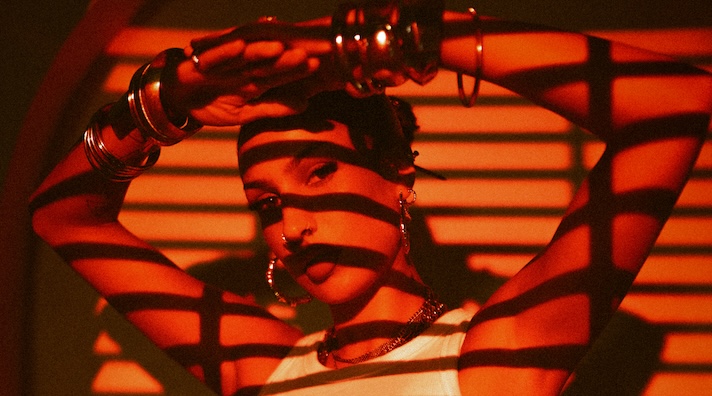
Joyce Wrice Unapologetically Embodies a ‘MACHIKO’ in New Album

There’s a newfound vibrance of self-assurance that runs through Joyce Wrice’s new album MACHIKO, one that doesn’t come at the expense of emotional vulnerability. Gliding between sultry roller-funk, dreamy r&b soundscapes, and silky neo-soul, the album is a snapshot of growing into a woman you’re proud to be and navigating that through love: wanting to be chased but not tied down, embracing independence while still longing for someone, and learning to recognize the ways in which your own fears can keep you from the very thing you desire.
Hailing from Chula Vista and now based in Los Angeles, Joyce Wrice has captured the hearts, and playlists, of a growing number of supporters through her soulful sound and empowering relatability. Following her acclaimed 2021 debut album Overgrown, Wrice returns with MACHIKO. Named after the Japanese word for “city girl” and the middle name bestowed upon her by her mother, the album draws on the hopes and possibilities woven into her identity, reflecting the woman she is today. Moving beyond the familiar terrain of heartbreak, Wrice explores vulnerability, desire, and the courage to let herself be fully known, balancing sensuality and playful abandon with emotional clarity. Featuring contributions from SALIMATA, JID, Odeal, Ty Dolla $ign, Eem Tripling, Rio Da Yung Og, and Mack Keane, alongside production from D’Mile, Lido, Jay Versace, Malik Ninety Five, and Mack Keane, MACHIKO captures an artist stepping confidently into her next chapter, embracing the uncertainty of love and the freedom of becoming herself.
After opening with a streetlike soundscape and lingering “I could be someone you love” with “MACHIKO,” the third track, “Dangerous,” establishes this strutting self-assurance through its deep ‘70s funk bassline and dash of retro keys. The bass acts as her steady stage, giving Wrice room to command the track with a smirk-filled tone that shines on “Don’t hurt yourself.” There’s an effortless quality to her falsetto, gliding over the groove with an embodied confidence. The backing vocals are an atmosphere all their own, driving the honey-laced funk the song is seeped in. Yet beneath the track’s playful swagger holds a pointed callout of the double standard surrounding women who embrace their confidence, particularly when it comes to their sexuality and self-expression: “Feels like you can speak it out / but when it’s me, I’m not allowed.”
On “Catch Me If You Can,” featuring JID, the soundscape shifts into a love-haze built from sprinkles of harp, sparkly twinkly overlays, and filtered gospel-esque vocals singing, “We can share our love together / Forever, you and me.” There’s a noncommittal push-and-pull to the track, as Wrice relished in the passion of the chase while remaining standoffish to being tied down, admitting, “I guess I like the chase better than the man.” JID’s feature adds a glimmer of desperate devotion, traveling every which way just to get to her. As his verse unfolds, her voice naturally weaves back in over his to take off where he left it, emphasizing the effortless flow between their perspectives. The track’s chemistry lies in that contrast: his willingness to chase after her meeting her own uncertainty about whether she wants to be caught.
“Until Next Time” brings a hypnotic chitter of drums that underscores a more assertive side of Wrice’s vocals. There’s a definitive understanding of who she is and how she goes about her love life, and she makes little room for argument. If she’s not in the mood, she simply won’t entertain it; when she does want someone, she’ll let them know, promising, “Until next time, I’ll see you soon.” There’s a freedom in this approach, a refusal to entertain expectations that don’t align with her own desires. But even with her bad-b*tch attitude, she retains a sense of emotional and self-awareness. Beneath the decisiveness is someone still working through the leftover emotions of a breakup, reckoning with the wrongs she might have made along the way. That tension makes the track more than a declaration of independence. It’s also an acknowledgment that knowing what you want doesn’t necessarily mean you’ve figured everything out.
The emotional complexity carries into “Wish I Knew,” featuring Odeal, a neo-soul duet steeped in the lingering feelings of a love that hasn’t quite run its course. There’s a noticeable softening in the chemistry between their voices, which envelop one another as silky guitar strums flow around them. The track explores the clarity that can come with time apart, particularly when distance forces you to confront the ways you might have contributed to a relationship’s unraveling. Wrice comes to a personal realization about her own avoidant tendencies, recognizing that wanting to make things work also means being willing to make the effort. There’s a bittersweet acknowledgment of her feelings, a confession that feels all the more affecting because he recognizes them in her, too: “Doing what you’re doing ’cause you’re scared of love.” Rather than positioning either person as entirely at fault, the duet allows both perspectives to coexist, its smooth instrumentation giving their vulnerability room to breathe.
“2 AM,” featuring Eem Triplin, conveys the mental gymnastics you go through when trying to uncover what you actually want with someone. Do you desire the person themselves, or do you desire the feeling they give you? It’s the kind of question that creeps in late at night, when longing, jealousy, and uncertainty begin to blur together and you find yourself wondering what the other person is doing, who they’re with, and whether they’re thinking about you too. The jumping bass drum feels like a heart skipping a beat, while the flickering warmth of Wrice’s vocal runs lends the track an intimate, restless quality. Eem Triplin’s feature adds another texture, with the beat momentarily warping around him as he offers the other person’s perspective. His desire to rekindle things complicates the song’s emotional back-and-forth, particularly when he suggests they “should rekindle.” Suddenly, the uncertainty isn’t entirely one-sided; there’s another person caught in the same cycle of wanting, wondering, and weighing the possibility of trying again.
Feeling like the final piece of the puzzle, is “Down To Earth.” It’s softer and more openly adoring as a warpy echo of electric guitar gives the song a floaty effect, with Wrice’s gentle vocals swimming through the instrumentals as though suspended in space. There’s a sweetness to the way she expresses her yearning: “No, I can’t read your mind, boy / Come back down to Earth world / And I’ll show you, every piece of my heart.” The dreamy production reflects the vulnerability of wanting someone to meet you where you are, to step outside their own uncertainty and recognize the love being offered to them. Where other tracks revel in the chase or assert the freedom to walk away, “Down To Earth” makes room for the desire to be understood. It’s a tender reminder that beneath all the confidence, emotional defenses, and complicated relationship dynamics, there remains a willingness to let someone in.
Taken together, these tracks paint a portrait of someone learning to explore love and connection on her own terms. She can be flirtatious and elusive, confident and guarded, self-aware yet still uncertain of her own feelings. The album’s strength lies in its ability to hold these contradictions without forcing them into easy resolutions. Its funk grooves and dreamy neo-soul textures give each emotional state its own space to exist, whether she’s strutting with unapologetic confidence or lying awake at 2 AM, wondering if she wants someone back for the right reasons. There’s growth in the way she recognizes her own patterns, but also freedom in accepting that self-awareness doesn’t mean having all the answers. Sometimes, it simply means knowing when to walk away, when to try again, and when to leave the door open until next time.
Listen to MACHIKO below:
![VITA Is Taking Her Power Back [Q&A]](https://s3-us-west-2.amazonaws.com/onestowatch-v2/copy_of_m_i_k_a_y_l_a393042468-_r1-015_photo_by_mikayla_lo_basso-1791244306.jpg)
![Master Peace's Sophomore Album, 'if i don't love you, who will?' Is Infectiously Good [Q&A]](https://s3-us-west-2.amazonaws.com/onestowatch-v2/m_a_s_t_e_r_p_e_a_c_e2570-1791298378.png)