
People I’ve Met Open Up Like Never Before
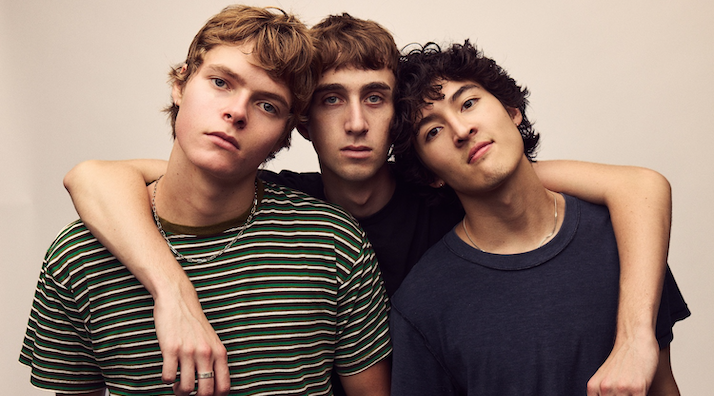
Photo by Mikayla LoBasso
Made up of Moses Martin (lead vocals, guitar), Orlando Wiltshire (drums), and Andrew Suster (bass guitar), NYC-based band People I’ve Met have spent the better part of the last year reorganizing their ambitions and identity. They shifted from their original DANCER moniker, booked themselves for bi-monthlyish shows at several of the cities premiere indie venues, and rolled out fresh material to be included on their debut EP, Bunny, out now.
Despite roadblocks in the creative process with the latter pair now living in New York full time while Martin spends much of the year as a student at Providence, RI’s Brown University, the band’s sound, as well as its live show, began to take shape. Performances at Main Drag Music in Williamsburg, Brooklyn and the Manhattan’s famed Mercury Lounge earlier this year saw them debut new tunes like “Bastards” and “Loving One” as well as revisit standard fare like “We Like Making Noise” and “Promise.” Of the three, Wiltshire shines brightest in a live setting, acting as the de facto ringleader of the group from the kit while markedly showcasing his skillset.
Bunny consists of five tracks and is highlighted by the synth-heavy “Promise” and the waxing poetic “For Hire.” Written from authentic points-of-view, the songs detail the erratic trajectory of love, as well the facets of it they don’t yet understand, such as on “Loving One.” Impressively, several of the tunes stray from the typical addendum of a double chorus in its latter half, opting to add fresh perspectives and uncharted thoughts. The trio have coined this development as one of their signature tools.
The sole tune from the new project without a live performance, or even a lyric video, is closing ballad “I want it I want it.” Highlighted by frontman Martin’s stunning, and shockingly pristine, falsetto, the tune is evidently profound on a personal level. When pressed on the reasoning for the lack of content, Martin was sheepish, but extremely forthcoming.
Onstage, Martin appears rather guarded, despite his discernable talent. In conversation, he is exceedingly open and expressive, detailing renown works of literature and educated methodologies behind his songwriting and concepts. Suster and Wiltshire, both of whom are equally quick-witted, curious, and capable of academic discussion and exploration, keep him on his toes, as the trio’s comedic interplay is apparent throughout.
In an amusing twist of fate, this writer misinterpreted the liner notes of project title Bunny, inquiring if its lineage was tied back to a popular contemporary idea called ‘The White Rabbit Theory.’ The band, though not acquainted with this topic as it pertained to the conception of their project, were still able to examine its relation to the thematic elements of their music and lyrics on the fly. While many would taper off in this instance of unfamiliarity, the trio were able to participate in a formative discussion.
The band have recently released a string of live videos now available on their YouTube channel, including live performances of “For Hire,” in a van, “Loving One,” quite literally, from a distance, and “Bastards,” on a roof.
OTW: You all seem to be at home in the music video for “Promise.” How has the city inspired your sonic and visual aesthetic?
Orlando: For that video, a big thing New York has given us is this fun platform and the freedom to experiment at such a variety of venues and with such a variety of different types of people. It’s like a sandbox. We literally just bought a camera and were like, “This is a cool street, let’s film some shit here.”
Andrew: It’s a very cinematic city, especially at night by the river. I remember Moses talking about a lot of his film inspirations for this, which he can touch more on, but there were a lot of artistic moments we wanted to include. [Gushes] I love that video!
Moses: I don’t go to school in New York, but I spend a lot of time there and have my whole life. There’s a really unique quality New York has, especially at night, whether you’re driving or walking around. It contextualizes all your feelings and emotions in a really specific way that is beautiful, because you’re in such an inspiring yet overwhelming place. There is a real frenetic energy with a lot of color. That kind of color is something we try to capture in the music. If I can put a listener into a specific environment and contextualize the way they’re feeling, it’s a successful song. New York does that really well, so we like our music to have some of the same qualities.
The idea of cinema is something your generation of artists has really latched onto in terms of creating visual worlds. Why do you think your generation is so locked into the idea of cinema being almost a third party of your music?
Moses: Well, I think the reason cinema has had a renaissance with our generation, and, even recently, we’ve seen more people going to movie theatre’s, is because there’s a sense of escapism within movies. It’s a romanticized, idealized version of something larger than life that evokes a feeling when you’re watching it. For a generation that is so attached to moments, small moments, and short form content, it traps you in this small world. Cinema makes you look up and pay attention to things, think, and take a minute to not be on your phone. It’s really valued as an art form again, which is fantastic. As far as how it pertains to music, people are so dependent on visual language as well as sonic information to synthesize what they’re watching. So, the two really go hand in hand. If movies are this thing you can experience, people want that from music as well. AND, the way most music is found nowadays is when it’s connected to visuals. You don’t really hear songs on the radio anymore, you find it on TikTok, Instagram, YouTube. If people are finding songs connected to visuals, the two have been more linked than ever.
What drives the gradual build of songs like “Loving One,” “For Hire,” and “Promise”?
Andrew: Specifically for “Loving One,” Moses came into the studio with that verse and chorus and we knew we had to work on it immediately. That one really flourished and became a larger thing. It just speaks to the band environment, the sum of each part being larger than anything any of us could do individually.
Moses: It’s a great way to fully explore the range of emotion a song can have. It’s true to life as well, to experience a rollercoaster within a song. To explore different parts of the core emotion we’re trying to get at within each song. So, the build really lends itself to the way that we think and go about making music. It is the epitome of what we can achieve as a band. “Loving One,” for example, is me on the guitar for a minute exploring this one feeling and then everyone comes in and it’s this great rush of emotion. We’re starting to coin it, and we’re doing this a lot now where we have a bridge/outro. Not so much on the ones that are out now, but the ones we’re working on. With “Loving One,” we’re calling it “the br-outro.”
[Collective band laughter]
What’s the main difference of creating that build when it’s more of a synth-based build vs drum, bass, or guitar?
Orlando: The method stays the same, or similar. You can arrange it in a similar way and make it build with a different selection of instruments.
Andrew: Also, it feels pretty evident of what the song needs right when we start working on it.
Moses: A song like “Promise,” a lot of it I did in my dorm room, so I didn’t have access to these guys to get the full energy. So, it’s just in a smaller world of a computer where you can’t do dynamics on midi drums. “Loving One” is all of us in a room together experiencing it organically.
How did it feel to write the word vomit that is the bridge of “For Hire”?
Moses: Whenever I’m doing lyrics for anything, what I first will have is word vomit. Gibberish that, whenever a melody comes through, typically it comes through with some kind of words. Sometimes it’s gibberish, sometimes a little more clear. With “For Hire,” I felt like the song needed a br-outro. I was singing in that register, and I was just saying all of this stuff, and I was like, “What does this mean??” There are some funny lines in there, like “It’s a heavenly position for a quarterback.” The word vomit stuff is my favorite, when it’s the time to express any feeling. A real encapsulation of pure emotion.
How did the concept of not being afraid to express love while you’re young and able come about for “Loving One”?
Moses: That’s a great question! There’s no point of writing songs if you’re not doing it from a place of honesty or authenticity. That’s what I was experiencing at the time. It’s such a vulnerable song, not anything I would say to anyone, but when it’s masked in music, it feels easier to vocalize, even when more people hear it. So, I was really in that mentality. I’m not going to try and cover this up by being like, “Oh, well, I didn’t even like you THAT much.” Also, what’s the point in feeling things if you won’t express them fully? Going through hard things as a musician is so beautiful because it gives you this emotional fodder to share your experience, and you’ll find out that a lot of other people are going through the same things.
Can each of you think of a song that defines how you feel about love?
Orlando: I have to look at my playlist… [Pulls out his phone]
Andrew: The first one that comes to mind is “From The Morning” by Nick Drake off Pink Moon. I don’t even know what that song is about, but lyrically, and the way that it’s performed, there is a sense of wonder and love about the world. To me, I can sit in any emotion and be appreciative of it and its purpose in my journey.
Orlando: I want you to make a decision for me of whether to choose romantic love or existential.
Existential!
Orlando: It’s kind of recent, but there’s this duo called Boards of Canada, and their song “Olson” is one of the most insane things to listen to. For like, a month straight, I would just put AirPods in and sit on a subway and levitate for a little bit. That was my favorite part of the day.
Moses: I have three, but I have to choose one, I guess…
Orlando: Tell him how the three are different and HE can choose! [Points to me]
Moses: I’ll tell you the three, and you can decide.
[Laughs] Y’all are cool.
Moses: YOU’RE cool. These are FANTASTIC questions. The first one is “I Hope That I Don’t Fall In Love With You” by Tom Waits. Like… what a scary thing to do! You can really fuck yourself up with that. The second is “Song For Zula” by Phosphorescent, because it captures the swelling feeling of intoxicated love and the melancholy that comes with it, for me at least. The third is “The Cure” by Olivia Rodrigo, which is such an incredible understanding of how you can be so in love but that won’t fix your problems. You still have to do the work and get through life.
Orlando: That’s such an interesting question, because I started thinking about songs from my childhood, but I feel like I’m in the state of my life where those songs are coming into play now.
Why?
Moses: [Pulls his hat over his face] Yeah, what do you mean?
Orlando: I would expect a formative love song would come to me from when I was like, seven, but I went through my playlist and found the song that I found three months ago. So, maybe I’m figuring out love right now. Or maybe I never will!
Moses: [Snickers] Whoa. That’s deep!
Moses, can you explain how you developed the cleanliness of your head voice and falsetto?
Orlando: It’s SO clean [Leans back with a smile].
Moses: Gosh, it is clean. It’s a funny thing, because sometimes in my chest voice I get a little low and gravely. I love the separation between this angelic possibility with head voice, and the low thing, like The National, that I sometimes do. I don’t even know how I got it to be that clean. I don’t have the biggest range in my chest voice. When I’m finding songs and writing, I write in a higher register because it feels more free. It’s a fun thing to experiment with.
I think myself, and your fans, have had a hard time deciphering the lyrics to “I want it I want it.” It reminds me of the first time I heard a song you may know well, Moses, called “Midnight.” Can you give a brief overview of the lyrical journey of that song?
Orlando: I LOVE this story! I’m so glad you asked this.
Moses: A great question, again…
Orlando: [Taps Moses on the shoulder] Tell him!! What are the lyrics to the song?
Moses: This goes back to the word vomit. When I figure out lyrics, a lot of it is stuff that sounds like words before there really are words. On “I want it I want it,” I was trying to do real lyrics, and I was like, “You know what sounds cooler? Half understandable lyrics that don’t makes sense.” At first, I was scared by that idea. There ARE real lyrics in it, but a lot of it is sort of gibberish. It’s a scary idea, but then I thought about the Cocteau Twins, and I NEVER know what they’re saying. Or Sigur Rós, who invited their own language. So, again, why mess with the feeling?
Andrew: The original voice note for it had a pureness to the writing process that felt like it deeply tapped into what we’re doing. It was an ode to that feeling and emotion to let that be the final version.
Orlando, how do you approach the physicality of what you do during the live show?
Orlando: I think I should do a bit more warmup, cause I don’t do much. [Asks himself] What DO I do? I try and get hyped up, but to not use too much energy until the last song called “We Like Making Noise.” That’s when I’m ok with destroying my body for the night, so I’ll hit as hard as I can. Then after, I’m a little fucked, but it’s fun! I have to let my demons out a little bit every time we play.
Andrew: You gotta control em…
Orlando: I feel a little stupid sometimes…
Andrew: Orlando and I can look at each other and give each other looks and improvise things within the constraints of it sounding good. There are some songs where he’s just SO locked in.
Now that you’ve started to find your footing as live band, what’s your favorite part about adapting these songs for a live setting?
Andrew: It forces us to be more of a band. All three of us love writing and production so much, and there’s so much you can. Like, at the end of “For Hire,” there are five vocal layers all doing different things, so when we had to play it live, we were like, “We can’t do that.” For that song, and others, it gives us more limitations, which I think makes us better.
Orlando: And, in some ways, less limitations, too. I agree with you…
Andrew: I agree with your disagreement…
When did you first stumble on the white rabbit theory?
Orlando: Is this like… a pop culture thing, or…?
Moses: What… what’s the white rabbit theory?
The white rabbit theory is the idea that certain relationships and certain things in your life have to end at a certain time, and that’s what I assumed the title Bunny was referring to…
[Collective band murmuring]
Andrew: Wait, I’ve seen this. Is that the thing with the rabbit pointing to the clock?
Yes!
[More collective murmuring]
Orlando: That wasn’t just a joke??
Andrew: You just connected the dots for us…
Moses: NOW is when we stumbled on it! Wow, ok. I mean, the true answer is, the reason I liked the name Bunny is because I was reading The Secret History by Donna Tartt, which is my favorite book. There’s a character in it called Bunny, and I thought, “What a cool name for somebody who wasn’t an animal.” The name Bunny lends itself to being a pet name for a partner, or a term of endearment for someone you love. That, in the context of the… trueness, of the EP… is that a word? I don’t know. But, yes, I, that… wow, ok, well, you…
Andrew: That ties in very well…
Moses: We should have thought of that.
I had a really deep question about it that I can’t ask now…
Moses & Orlando: [At the same time and in the same cadence] What was the question?
What do you think is the most challenging realization about the loss, freedom, and abruptness of knowing that those things have a timeclock?
Moses: It is a very present thing in the music, still, so we could answer this…
Please provide!
Moses: Well, I am naturally a somewhat existential person, in the sense that I have trouble with the idea that everything ends. Or, I did for a long time, until you find the freedom in it. I never hold any emotion entirely wholly. I don’t think anyone really does. All emotions are fluid and there are a wide range of colors…
Orlando [Interrupts] Like the movie Inside Out. Sorry.
Moses: Exactly. Sometimes its freeing to know that no matter what, this will end, and you have to accept that and pretend to be happy in the moment. That’s most of life. There’s a sense of playing pretend we all do to get through it, because it’s the only way we really can. It’s a beautiful thing that everything ends, and life would not be so sweet without it. AND there’s a sense of hope in it, when you’re going through heartbreak or sadness. So, it does play a prominent theme in the music, even if it’s not what we originally thought of for the EP.
Andrew: The emotion of sadness is great, because it’s something you care about…
Moses: [Rolls his eyes] Sometimes…
Andrew: For me, all the time. If I’m upset about something, I get to care about something so deeply. If a song is making me mad because it’s not coming out the way I want it to, I love making music so much and I GET to care about that. If I’m sad about losing a girl, I loved that experience.
Moses: FUCK. THAT. It sucks. I don’t care. I’m kidding, that’s a very good point.
Orlando: This reminds me of a quote from South Park. I’m fully serious, by the way. He’s just like, “Even though you’re sad, you’re sad because something happy happened before, and you’ll have the opportunity to be happy again.” Something like that. I saw it on TikTok. Loved that shit. Saved it.
Moses: [Pulls the hat down over his face again] Yeah, okay…
Thank you guys for chatting. Moses, where is this personality onstage?
Moses: [Freezes] Like… this… [Points to himself]?
Yes, you! Where is this conversationalist onstage?
Moses: [Shrugs] He goes into hiding. I think about how I should talk more onstage, but then I get in my head and think, “No one wants to hear this.” Maybe next time, I’ll do it.
![Moody Joody Draw Us Closer to their Debut EP, Plain Jane [Q&A]](https://s3-us-west-2.amazonaws.com/onestowatch-v2/unnamed-1791228468.jpg)
![Everything You Need to Know About Janine Berdin [Q&A]](https://s3-us-west-2.amazonaws.com/onestowatch-v2/save_vid._net_825323764_18639518701012760_1512066654651545567_n-1791395650.jpg)
![La Niña Is Learning to Let the Unknown Lead Her Ahead of US Debut [Q&A]](https://s3-us-west-2.amazonaws.com/onestowatch-v2/eleonora_albano-_d_s_c05998-1791394944.jpg)