
Sophia James Finds Synchronicity in the Unexpected in Her EP, The Wrong Shoe Theory [Q&A]
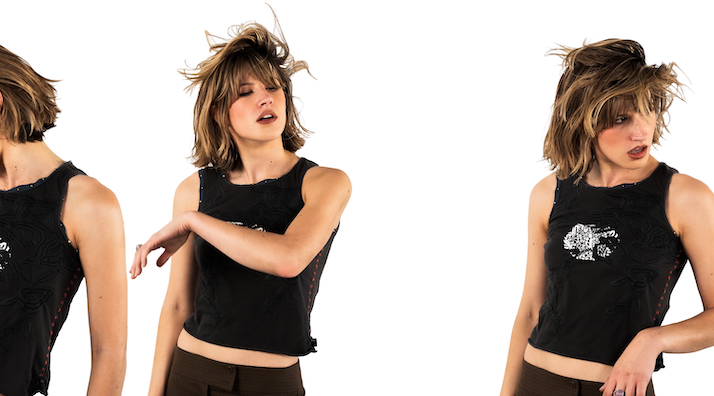
Photo by Stephanie Saias
The daughters of drummers are mercurial by upbringing, labored into paradiddles of curiosity, never too shy or willing to be too quiet. Even more so, if their imagination is both fostered by the discipline of jazz, then flavored with the pop essences of the 80’s & 90’s, resulting in an absolutely quirky, positive sound that feels sticky to your ears. Sophia James is remarkably talented, enough to be understanding of what to leave out in an effort to communicate the best of pop sounds. And on her latest EP, The Wrong Shoe Theory, her ability to nuance cheeky lyrics, silky choruses and blissful melodies is just so damn fun. Wanted to know more about her styling (wrong shoes?), her unique upbringing and more, we had the pleasure of hosting her in our content studio to dig in:
OnesToWatch: Who are you?
Sophia James: Oh, what a great question. I'm still figuring that out. I was given the name Sophia, when I was born, born to the name Sophia Wackerman. I changed it when I started the artist thing because nobody took me seriously with a last name like Wackerman. People are afraid of the whack, you know. There's a lot of jokes surrounding it – like, whack her man, you must be so wacky. You get it. My dad is a drummer, so it works perfectly for him. Didn't quite work for me as a solo artist who is trying to do something earnest here and there.
I already know you had a great childhood, because your dad's a drummer. That's got to be fun.
Oh, yeah. It was.
There's no rules if your dad's a drummer.
Well, surprisingly, he was quite strict.
Was he? Oh, was he a jazz drummer?
Yes, precisely. Well, jazz fusion. So there was some playfulness, but there were a lot of rules, a lot of boundaries. And my late mother was a singer, they met on tour. So it was a very musical household. Music was very encouraged. I was very lucky to have easy access to music education in the household. I took to it really early on. I loved it and I knew that I never wanted to do anything else. I was just very completely and utterly obsessed with melodies and chords and composition and harmonizing and arranginging and everything musical for as long as I can remember. I grew up a theater kid. I loved performing. I did show choir in high school, it's like Glee. Singing and dancing on the riser, very gimmicky.
Very wacky (Whacky).
Perhaps that's who I am in a nutshell. That's the recurring theme. I studied jazz at UCLA but I'm not a jazz artist by any means. I don't claim to be. But I wanted to sort of have a good foundation and understanding of jazz so that I could translate it over to whatever genre I chose to pursue. I fell in love with songwriting and making music from the ground up during my college years. Ever since, I've just been paying my rent with probably a million and one odd jobs, all revolving around music and within music. I have done many a piano bar, restaurant gig where I'm playing for four hours as if I'm wallpaper to a crowd that isn't listening. I've been an opening act for various artists going on tour, and I've been a keyboard player for people's bands, I've subbed as a singer, I've been a session singer, I've been a writer on other people's stuff. I've written some music for TV shows.
You're busy.
Oh, sure. This is LA. It's expensive. I coincidentally spend my time making music in whatever capacity I can. Throughout all of that, I knew I wanted to pursue the solo artist career and write my own material and make my own stuff and experiment around. I started releasing my own stuff circa 2020. Great year, nothing dramatic happened that year. It was pretty mellow. For the record, it's sarcasm. But I did meet my current collaborator, Alex Billowitz in 2023, and I hadn't really been too keen on cowriting or collaborating before. I was very much a lone wolf. I started working with Alex and realized that it was so much fun. There were sounds and musical worlds that I hadn’t explored before that I got to tap into. We just had very good musical chemistry. Eventually we ended up with an album's worth of material. Some selections from that piece of material is what has become the Wrong Shoe Theory EP.
Okay. You stole all my questions by answering everything.
I'm a rambler. I’ll drive into the ocean, man, if you don't stop me.
No, I love it. Let me ask something completely non-topical, but also interesting. Where did you get that jacket?
I thrifted this in 2022 in Portland, Oregon. I am very intentional about the pieces I buy.
Tell me more about your style, because it’s unique. And I must say, listening to your music, it's refreshing, because I feel like I could be in the 1980s or early 90s.
You're saying all the right things.
How do you express your style in your music?
I try to approach it from a sense of play. I very much look to the past to create what's next. I am deeply inspired by the music of the 70s, 80s, 90s, pre-auto tune.
There's a time and a place that I think it can be used very artistically.
I take the point. There's just something about that era of music when the session players had to be so locked in because they didn't have a lot to hide behind. It was just pure energy or pure emotion and absurdity and it was loud and it was exciting and horrific and I just am so obsessed with it. So, in making the Wrong Shoe Theory and the album that is coming out after it, I was doing a lot of listening to that world of power pop. The dramatic post Beatles-y, Elton John, the Knacks kind of world. Talking Heads. I love the live sound. You know what else it is? The concerts seem like they were so fucking great back then. I just would give anything to be able to experience a rock and roll concert pre-smartphone. I have an envious nostalgia for that pre-smartphone world. I think that kind of comes through in my music.
I call it false nostalgia, not saying it's not felt or meaningful. It's just that you didn't actually live through that, but you're nostalgic for it. I wonder if it is this digital-analog divide, that inability to fathom going to a concert without a smartphone.
Yes, exactly. And just being so incredibly present and not existing in this panopticon that we do now and letting loose and really feeling everybody's energy around you. That's part of the reason I love performing, is because I love creating spaces where people can come and just like absolutely feed off of each other's energy and rock out and jump up and down and get sweaty. Music is the conduit for that. It all ties together in some way.
Let's talk about your process a little bit, because obviously, you mentioned a pretty jarring change in that you've adopted a cowriter. What's changed most since?
It's been really nice to have a sounding board. I'm so quick to throw something out.
In a self-critical way, or you just have more ideas?
I guess in a self-critical way. If I start a tune and it's not going anywhere and I don't think it has any potential or it's not quite up to the standards that I've set for myself musically, I'll just toss it. But having a collaborator in the mix has been amazing. There are some songs on the album that almost died, but were saved because there was another voice in the room saying, actually, hold on. Here's what's good about this. Let's try and mold it and shift it in this new way that perhaps you hadn't thought of before, Sophia. I never would have thought of that. I can get sort of stuck in my own creative loops and having a sounding board has made all the difference. And also, Alex is one of the greatest producers ever. He's so fast. He's so skilled. He's very tapped into the world of production and he knows exactly what each song needs. Being able to be in the copilot's seat and learn from him has been so fun.
How do you normally sort of write a song? Do you start with melody, topline? Do you have ideas, themes, all the above?
It really depends on the song. I wish I had a straightforward answer. I know some people are very regimented about their songwriting routines. Typically, I'll have an idea, a feeling, something I want to express or say, or an experience that I want to meditate on and figure out. I will lay chords down, whether on piano or guitar. I typically reach for either one of those because that's what I have access to and want to know how to play. Then I’ll make a top line of a mumbly melody next, and try to sketch out words and puzzle piece rhymes together. I think I pay a lot of attention to the rhythm of how words flow and how melody flows…
Daughter of a drummer.
Yeah, yeah, yeah. That's definitely made a lifelong impact on me. When it comes to lyrics and what stays and what goes on the chopping block, it always comes down to like what works rhythmically. Even if it kind of muddies up the meaning a little bit, I will always prioritize rhythm and feeling against narrative. I like that because there's a mystery to the lyrics sometimes because of that. They're open for interpretation because they're not deliberately meant for exposition. It depends on the song too, sometimes I would be very hyperspecific with narrative or poetry. But other times I will intentionally leave things up to interpretation because I don't know. Some of my favorite songs are so vague, but they mean absolutely everything to me. That's the meaning of everything, and I'd like to try and offer that same experience to those willing to take it.
Are there any right shoes or are they all wrong shoes?
No.
Okay. Is the title meant to explain that we're always ill fitting and not at home with ourselves? What's your interpretation?
I like to leave it up to the interpretation, but if you want the authority thought process...
Would love it.
The wrong shoe theory is this idea or concept in styling. I think it's a fairly newer term. It's the idea that pairing the so-called “wrong shoe” against the rest of your outfit elevates the entire ensemble. Juxtaposition. So think, basketball shorts, and athletic wear with a pair of fancy heels. Or an evening gown with sneakers. There’s a subliminal chicness that it evokes. It's playful and unexpected. I just love that whole concept of mismatched things. Carrying it across to the music on this EP, it’s quite fitting because there's a lot of elements within each song and the project altogether that just shouldn't really fit, but I think the unexpected elements of it are precisely what makes it so special.
I love it. Do you have an ambition for this EP and does it speak to the album that's upcoming?
It's an appetizer to the album. It's a small window into what the rest of the album is going to sound like. It's the most musically ambitious I've ever been. For the longest time, ever since I started writing and releasing my own stuff, I restricted myself to writing only heartbreaking or gut wrenching stuff. I really wanted to portray myself as soft and tortured and feminine and every song had to be so profound and have all of the answers to life or just rip your heart out. I don't know why. But restricting yourself to only one emotional expression creatively is kind of like tightening a titanium corset. If you pull the strings too tight, your blood and guts are gonna spill over all four walls of the room. I think that's what happened, when I started writing this album and this EP. All of these other emotions spilled out onto the walls and it was so loud and ugly and messy and there was rage and there was euphoria and there was just absolute disillusionment and confusion and absurdity and cheekiness. All of this stuff that had gone unexplored and these high voltage emotions, that's what the album is. It was not on my bingo card.
The titanium corset gut experience. I like it. I'm going to pivot to some fun questions. Best era for women's fashion?
I love the '70s because there was a lot happening in terms of women's rights, and fashion is always political, and it will always reflect the times. There was a lot of differentiation going on. Women were wearing pants for the first time in a real way. Bell bottoms were all the rage, and they were wearing stuff that played with the masculine and the feminine and just allowed for more freedom and mobility. It seemed like it was less restrictive, which I just love. I also love the 20s. The flapper era is so chic and fun. The riskiness of raising the skirts for the first time because you wanted to, and bumping your hair because it's c*nty. I also love the 90s. I love the sort of tomboyness that came into play with women's wear. I'm super drawn to very androgynous fashion.
What about men's fashion?
I think they were really gone to something in the Renaissance. We got to go back to when men were wearing stockings. Everyone was walking around like a painting. Lots of buckles. The puffy sleeves. Those paintings of Shakespeare with the frilly neck thing. It was so colorful. It was so creative and playful.
Is jazz the most American art form, and if it isn't, what is?
Oh, that's a really good question. My instinct is to say yes. But at the same time, jazz is a product of other cultures. The most American thing is melting pot culture. So in that way, yes, jazz is the most American art form. But at the same time, jazz only exists because of African music, and those rhythms and melodies and phrases only exists because there was trade between Africa and the Middle East, horrific slave trade, and enslaved Africans were brought over to the states and the Blues formed as a form of protest and that grew to jazz. If you really trace it all back, jazz is everybody's music, not just America's music.
That was beautiful. What is the most American art form then?
Some people say baseball. Who knows?
Last couple of questions. I would love a non-music recommendation, so it can literally be anything.
There is a book called Free Play by Stephen Nakmanovich. Free Play: The Power of Improvising In Life and the Arts. So I guess it is somewhat related to music, but it goes beyond. That book is like the Bible to me. It basically goes into what improvisation is and why and how we can incorporate it and how we use improvisation. I'm improvising right now by talking to you and you're improvising some of these questions, maybe. Everything is improvisation and everything is playful. After reading that, my relationship to music was pretty much changed forever. I didn't take it as seriously. I really tried to start approaching it from a sense of play and improvisation and curiosity. It did wonders for my like mentality and my attitude in life, too. So I would always recommend that.
I love that. I got to say, you're one of the few artists whose curiosity radiates off them.
Oh, that's very kind.
It’s beautiful. I need to follow up with a music recommendation.
My buddy Eli has a band called Thumber. They dropped an album earlier this year called Goodbye Car. Earnestly, not just because I know him, it's one of the best albums I've ever heard. It's fantastic. There's some MGMT-sounding stuff in there. It's my buddy, Eli Torgerson and Virgil Tunis, who is Scott Tunis's son, who was Frank Zappa's bass player. Virgil also has a sister, Hazel, who is lovely. Hazel Novava is her artist's name. She has a song called “I Got You” that is criminally underrated. I don't know why it's not on the charts. It's the coolest sounding thing I've ever heard in my entire life. So I will definitely plug those.
My dad's a huge Frank Zappa guy.
Oh, no, way. My dad was his drummer.
Well, then that makes a lot of sense knowing your dad is disciplined, but also, you know...
Oh, yeah. It was rock and roll, but Zappa was like, no drugs, no alcohol. He was very strict that you can't play his music if you're fucking around.
I guess that's what revolutionaries need, right? You need to be disciplined.
I guess so.
I’d like to end on your words! Advice, antidotes, jokes, sh shout outs, promos, high moms, whatever.
I've got two headline shows, one in New York at Baby's Allright on June 17th, and one here in LA at the Echo on June 26th. Come one, come all. It'll be a hell of a time. It'll be really fun. And also, take care of yourself, do whatever you need to do to find joy in this life, as long as it's not hurting anybody.
Brilliant. Well put, thank you so much.
Thank you.
![Moody Joody Draw Us Closer to their Debut EP, Plain Jane [Q&A]](https://s3-us-west-2.amazonaws.com/onestowatch-v2/unnamed-1791228468.jpg)
![Everything You Need to Know About Janine Berdin [Q&A]](https://s3-us-west-2.amazonaws.com/onestowatch-v2/save_vid._net_825323764_18639518701012760_1512066654651545567_n-1791395650.jpg)
![La Niña Is Learning to Let the Unknown Lead Her Ahead of US Debut [Q&A]](https://s3-us-west-2.amazonaws.com/onestowatch-v2/eleonora_albano-_d_s_c05998-1791394944.jpg)