
Culture Wars Favors Real Instruments and 90s Grit on Debut Album, "Don't Speak" [Q&A]
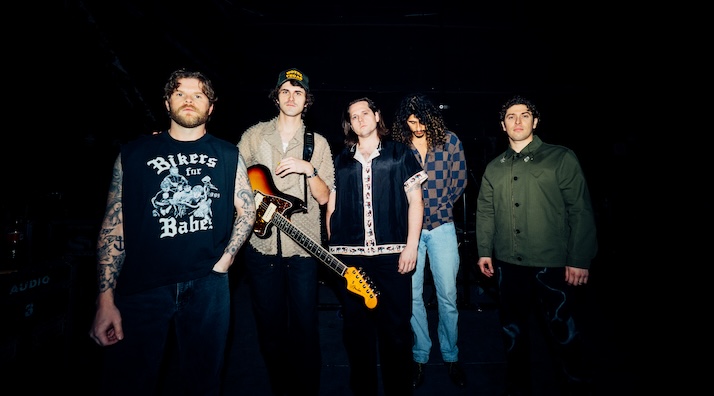
Photo by Eliot Lee
Fresh off of signing with AWAL, the Austin-bred, alternatively-fueled band Culture Wars has released their debut album, Don't Speak. The album reinvigorates guitar music, blending the tenacity of 90s rock with the pristine of modern production. Curious as ever to get to know the inter-band dynamics and creation of this stunning debut, we chatted with Culture Wars to get the scoop:
OnesToWatch: Who are you?
Culture Wars: We are Culture Wars. A band of five dudes from Texas that play rock-ish music.
Texas bands. Texas Boys. How did it all come together?
Alex: I moved to Austin trying to meet people, and through a mutual friend, I met our drummer, Dave. This was when I was at UT. And then a childhood friend of mine, who I played Little League with was like, oh, I know a bass and keys player that's in Austin. You should meet him. That was Dylan. Then Josh and Caleb were interns at the studio at the time when we were making the previous band before this. So we just all met.
Socially recruited. I love this. It was real IRL. What makes this band work?
Alex: I think the differences between everybody. Instead of all being on the same page, it kind of works that we all pull each other in different directions. It's a yin and yang. Later on, it made the band name make sense in our own way, because we do disagree until we don’t. When we disagree, I’ll say, “If I wanted to do this by myself, I would, but it wouldn’t be nearly as good. Can we all just figure this out?” There’s a push and pull.
Especially creatively, we have different influences, but that makes the outcome even better. We also have such a natural chemistry. We're all very close and spend a ton of time together. That chemistry can be felt and it's built over time in the creative process and on stage and even just in rehearsals.
What is the spectrum of influences across the band?
Caleb: It’s pretty wide. I'm all over the place, like I love R&B, that's mainly what I produced and wrote before meeting these guys. This is the first alternative thing I've ever done. I love modern day Frank Ocean, I love hip hop, I love Travis Scott, Stevie Wonder, Pharrell, Aphex Twin, Radiohead. All of that comes through in our music in one way or another, whether it’s the groove or a melody.
Alex: I'm more of a rock listener. I'll listen to Nine Inch Nails, but Dave won't. Dave and I both grew up going to the rodeo – I went to the Houston one, he had his own thing in Dallas – so it was a lot of country. I was surprised how much that seeped in with me. I think Dyl and Josh hit on some of the more indie stuff. It’s good, we have every genre covered.
In terms of process, how do you guys write? Do you individually write and then come together, or do you jam it out?
Alex: This album has been deliberate, mainly just because Caleb was like, we need better songs. We need to focus on the song. So we adopted this method of “song first.” So, if we didn’t have a guitar and vocal or a piano and vocal outline established first, then we just didn't record the song. That was our method instead of building a bunch of tracks. We wanted to make sure the melody and song were there. That opened up the band up to feeling really free with the recording process, because we already trusted that the song was good. Everyone could add their piece and feed themselves within it. I think that made a more cohesive thing for everybody to have their own piece of the puzzle. But in terms of getting there to those songs, sometimes it's me and Caleb, sometimes it's me and Dylan. It's really wherever it comes from. Doesn't matter.
Caleb: We're pretty regimented. It's pretty much like Tuesday, Thursday I’m at your house and we'll make stuff. So it's just the commitment of showing up multiple times a week and that opens the space creatively. From that point really, it's just whatever's being listened to or I'll have an idea for a type of groove that I'm looking for. From there, we’ll build the track. We start with a bass and a snare, or a guitar part. Then, the melody has to work. I keep reshuffling the groove until it feels right for Alex to create a melody. Once it’s structured out, we bring it to the guys for instrumentation. It's a methodical process that we've gotten to. That wasn't the idea in the beginning, especially when we first started working together, it was just like, let's get an Airbnb and get as drunk as we possibly can. We got like one song out of it.
Give me the story of the album. Is it thematic? Are you guys trying to tie together every song?
Alex: No, the theme is the band, it's a band record. The songs come from different times. We wrote the album, and then we toured with a lot of people. The main thing that changed our minds was an Asia tour we did with Maroon 5 because they were talking about how they played our first album for three years and we were like, we do not want to play the back half of this album for three years. So we scrapped the entire back half of the album and rewrote it. Caleb produced it, so he had to go back and remix everything, too. And now we really like it. So it is kind of split up in time.
I don’t often get to talk to mixers, so I have a question. When you revisit songs like that for the purpose of tying them together, how do you do that?
Caleb: Well Alex does all the lyrics and everything. So I don't know about lyrical thematics. But for me, there are sonic and compositional thematics throughout this record that really tie it together. Also, the original plan wasn't for me to mix it. But after a certain point, playing these songs live enough, it just clicked to me what it was this record needed sonically. So tying things together is more about the placement of parts. Where do I hear Josh coming in, where’s Dave, where’s Alex panning-wise –left or right in the mix– and how gritty is the sound, how spacious is it? These are all the questions I ask as I’m adding effects. When I add compression, how squashed do I want it? How dirty, how loud is this? How can I make it sound like it's in a garage and we're just blasting through shitty speakers, but you can still hear everything and it's clear and it hits? That is all very intentional. And so I'm really visual when I do it. Even when we're deciding what tones and stuff to use, it's very much an energy. We went back to a lot of the same gear after scrapping the back half of the album, which is crazy because it was years apart. But by the time we did those new songs, we were a machine. The sonic tone was solid.
Do you guys have a collective ambition?
Alex: The half joke has always been Wembley Stadium. Otherwise, we're just putting our nose to the grindstone, getting to work. There's not a lot of room for screwing around, if that makes sense? Everyone understands what we're trying to do is something big and to be able to do that, we have to just be on it and ready to go and fire at any time.
What's the worst idea you guys have had as a band? And why did it end up being a good idea?
Alex: It's not the worst idea, but it was certainly a choice. When we got the opportunity to open for LANY in Asia, it was a tough question of, is it really worth it financially to pack everything up? To go to a market where we have no idea what we're doing and build from scratch somewhere very far away? Later, it became a great idea because it's one of our primary markets, frankly. But, at the time, it was hard, because we backed out of somebody else's U.S. support tour to go do it. But it worked out in the end. We'd be in a very different place right now otherwise.
That's awesome. If the band is to celebrate, do you guys have a restaurant you go to?
Caleb: We're getting sushi and we're drinking sake and beer and then more sake and beer.
What about on the road?
Alex: I know Dave does. He's very regimented about not drinking if there's a show for him because it's so physical. He gets to the venue three hours ahead of time. He’s very methodical about how he sets up his drums. I don’t really drink either. You drink every day for two months straight and all of a sudden your voice is sounding so good and you’re so sweaty on stage.
If you were to get into your most Zen state, where is it and what are you doing?
Alex: In Waymo on TikTok and there's no one around me. No one can speak to me. I'm in Zen.
That one's hard to top. It's pretty good.
Caleb: As a creative, I can be an obsessive person and time flies off the clock when I'm in that flow state of creating. Even after all these years, it's still so scary to approach the computer and intend to make something. But after that five to ten minutes of not knowing what I’m doing, it clicks in, and then 12 hours have passed and now I'm late to dinner and I'm so fully energized. That is the most Zen flow state. I really love and chase that place.
That's awesome. To end, we’d love two things. First, a non-music recommendation. A place to visit, book, to read, something you'd put a friend on to.
Alex: Mine's usually coffee related. I'm coffee obsessed.
Caleb: Mine's sushi related. It's a restaurant called Moto Azabu in Marina Del Rey. It's like this little hole in the wall. Very authentic Nigiri, good vibes. It's like a shitty looking sushi place that has amazing sushi.
Next, we'd love a music recommendation.
Caleb: There's this band that’s new to me. They’re called CAN. They have an album called Tago Mago that's super cool. The whole thing's just a massive jam. Each song is seven minutes, and the textures and vibe and these guys are crazy. There’s also this electronic artist called Autechre. Very ambient Aphex Twins adjacent, but less feet to it. Very great textures.
Alex: My son loves Rafi. That’s a children’s singer, I’m kidding. My real recommendation is the bands that are coming on tour with us. There’s a band called Softly and another called Will Awake. Actually, though, my kid's obsessed with the Smiths now, which is weird.
Wow, that's depressing.
Alex: Well, it's probably both of us. I also like Third Eye Blind’s first record. And Rafi.
Incredible. Lastly, we would love to end on your words, so it can be some wisdom, some antidotes, advice, shoutouts, promo, whatever you want.
Alex: For me, one thing that's worked for us a lot, is just simply being okay and present in failure and knowing that that's how you get better. I feel like a lot of the industry right now is shortcuts and songwriting camps and let's bring 10 songwriters in to do it for you. You've not learned anything and the second they leave the room, you're done, you're giving control over all these people and so I think just build it yourself and get your hands dirty and be okay with that failure because it's going to be really, really bad for like 10 years.
Caleb: Yeah, to add to that, we’ve been embodying more authenticity. I think if you're going to do art, you can have your influences – and you should – you should figure out who your influences’ influences are, and then use all that to compile a perspective on that genre. Because if all you’re basing your sound off of Billie Eillish, you’re just copying, and it's not going to move the needle. It's like Billie Eilish and Phineas are doing their authentic thing, and that needs to go for everybody. We also have an album out April 10th.
Thank you both so much.
![Moody Joody Draw Us Closer to their Debut EP, Plain Jane [Q&A]](https://s3-us-west-2.amazonaws.com/onestowatch-v2/unnamed-1791228468.jpg)
![Weston Estate Grows Up and Into Debut Album, 'Open Season' [Q&A]](https://s3-us-west-2.amazonaws.com/onestowatch-v2/i_m_g_8944_copy-1791395273.jpg)
![A Night Out in New York With Nautics + Their Debut Album “People Only Like Me When Im Leaving” [Q&A]](https://s3-us-west-2.amazonaws.com/onestowatch-v2/d_e_v_5828-1791220348.jpg)