
Hannah Cole Learned How To Live Outside of Reality, and Then Wrote Her Way Back Anyway [Q+A]
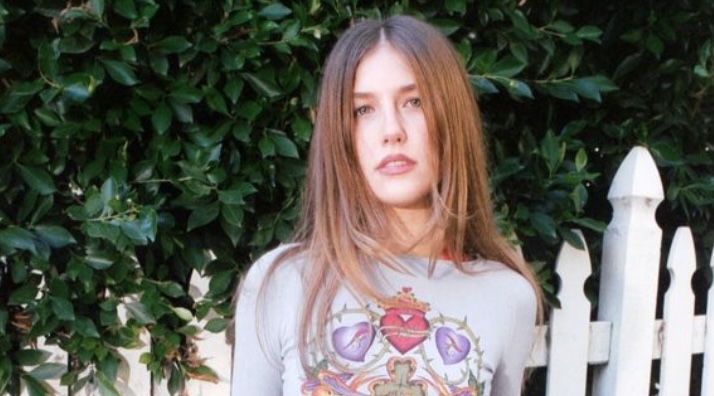
Photo by Adam Alonz
Last summer, Hannah Cole got stopped dead in her tracks by a call that her aunt had died. As if that wasn’t enough, she went through a health scare of her own very shortly after. Like anyone, she experienced a bit of an epiphany and started reckoning with why she was chasing success in the first place, and what it was costing her.
That crisis became what we now know as Switchbacks, Cole’s debut album, which is out now via Tight Knit Records. It opens with her driving through the Blue Ridge Mountains, watching the sunset recorded through bug splatter on the windshield, and closes with the same drive but in reverse. Switchbacks is a full-circle record about protecting the joy at the center of things once ambition gets its hands on them. In between the beginning and the ending are tracks of shoegaze-scarred, hook-driven rock that dig into the music industry’s uglier illusions and the patterns at how they’re applicable to society at large.
Cole was raised in Covington, Louisiana and is now Nashville-based, and writes in the same vein as Bully and Soccer Mommy, heaviness but with a tender dose of pop instinct and distortion wrapped around honey-sweet vocals. We had the chance to chat with Hannah about “Nashvegas,” falling back in love with music, and how to be ambitious without losing yourself in the process.
OnesToWatch: Switchbacks opens the album with that Blue Ridge drive, and "Mosquito Hawk" closes it with the same drive in reverse. Did you always know the album would circle back like that, or did that structure emerge after the songs were written?
Hannah Cole: I didn't know at first, because I didn't even know when I wrote "Switchbacks" that that was going to be the title, or that image would end up being related to the main theme of the whole record — the pursuit of success, and that journey. But when we were making "Mosquito Hawk," I knew I wanted it to land at that point in the record, because it marks a turning point in my way of thinking — switching from a more cynical mindset to a more hopeful one after looking back on that memory. There's a reverse-tape sound in the song that's meant to signify that journey going in reverse — going back into a memory, and having to go back in order to go forward. I think that's kind of the main theme of the entire record: you have to travel back in order to travel forward. Back and forth, up and down. The only way up is through, and you just need to honk your horn and let people know you're coming. I wasn't sure the two songs would be connected until most of the record was finished, but I'm really happy with how it turned out. The slowest songs on the record are the ones about stopping, slowing down, enjoying the view, and going back to something simpler.
You've said losing your aunt and then having a health scare of your own reoriented your priorities in the middle of making this record. How do you think that shift shows up in the songs that came after — is there a track where you can hear that change happen?
Yeah, I think it was "Every New Day" that was really inspired by those events. When someone passes away, it's a strange thing — one second they're there, and then there's a moment when they're just not. My aunt's passing was truly like that: very sudden. One day she was fine, and the next day she wasn't there. Then, having my own health scare and health anxiety — having these horrific images of myself, understanding my mortality in a way that creeps into your life more as you get older — I started thinking about how that related to my experience as an artist. There's this constant cycle of death and rebirth as an artist. For me, it was going on stage and feeling that rush of dopamine, people cheering, being able to do what you love — and then getting offstage and going home and thinking, "Wow, I need to go do all the mundane things of life now." There's a line in "Every New Day": one second you're there and then the next you're gone / I heard the click of a spotlight switch flip on and off. That's about someone being alive and then not — but it's also about being onstage, being "the special one," and then going home and realizing none of us are special. That humbling, slightly eerie thought actually brought me some peace, especially after struggling so much with the pressure to be successful, to make money, to hit every goal quickly. It reminded me that I need to actually be alive — to remember how lucky I am to be making music at all, and not let the pressure take away the joy of it. I thought that was a good way to close out the record.
Reading Joan Didion's Play It As It Lays got you thinking about Nashville as its own version of that Hollywood illusion machine. What's a specific moment where you felt like you were "living outside of reality"?
With "MMA," there are a couple of different images in that desert, Hollywood, kind of slimy world that I related to things in the music industry. For me, having to create a brand or an artist identity can, in itself, create an identity crisis — not because any of that is necessarily good or bad, just because that's the way it is. That's what I was trying to explore on the record: a fuller view of it. It's not necessarily bad to live outside of reality, or to have an artist brand. Maybe the industry is just competitive, and that's where some of the fighting imagery comes from. All of it — the glamour, the fame — creates a kind of identity crisis, where you're one person onstage, another on social media, and then just yourself in real life. A lot of artists are pretending to be a version of themselves, and the more we're taught to act the part, to dress for the part we want, the more people believe it and want it. I'm a victim of that too — I love when artists have a perfectly curated brand. I think it's a great marketing tool, but people get lost in it.
That song is mostly exploring my own struggle over whether I actually wanted to do music, and why. I didn't really know my place in the industry or how it worked. I'd have these tiny victories, people telling me they were obsessed with me, and then nothing would come of it. I'd start to feel competitive — why does this person get this opportunity? And then I'd realize: I'm getting competitive with people who are at the exact same level as me, while the people who are actually making money are watching us and laughing. I think the biggest point I was trying to make with "MMA," and honestly across the whole record, is that the industry is kind of a microcosm of the way the world works as a whole. The people at the top are going to be fine no matter what — the more we hate each other and compete with each other, the more they profit from it. It's an industry that claims to be progressive and always pushing forward, and I'm not sure it always is. I'm not trying to expose anything — I think it's just shining a light on something we already know.
"Mechanical Bull" comes from being seen as just the girlfriend rather than an equal in music spaces, while also being partnered with your co-producer, Josef. What was it like working with him in the studio while writing a song about that dynamic?
Working with Josef, being with him — he's my partner, we live together — making music with him is a completely positive thing. It's a safe haven from all the annoying stuff in the industry. So many men in the industry, especially in Nashville, love to pretend I don't really do music — that I'm just my boyfriend's accessory. When I was writing "Mechanical Bull," I told him I wanted to write about that experience, and he was completely supportive.
I wanted it to be clear that the only real antidote to that rage and frustration is when we make music together — when it's just the two of us, supporting and encouraging each other. I've never worked with anyone as closely as him, and over the years we've grown so much. On this record, he really let me shine. It's the first time I've had such a big hand in producing my own music — in the past I wasn't as confident. He helped me trust that my ideas were good and let me take the lead on pretty much everything. People who know me best say it sounds like the inside of my brain — like talking to me. That's all I've ever wanted from a record.
"Mechanical Bull" is an interesting one because I really hope people don't think it's about my partner — in the context of the record, it's meant to take place at an industry event. The image of a mechanical bull stood out to me because I don't want to be the bull — I want to be riding it, grabbing it by the horns. But with a mechanical bull, someone else is doing the controlling. You have this false sense of control. You think you're not the bull, you're on the bull — but even then, someone else is behind the scenes pulling the levers. It's about accepting that some people are just going to see me a certain way, and some people who pretend they want to help don't actually want to. A lot of people don't want to acknowledge women in that space, or give them money or support — especially in Nashville. Thankfully, making music with Josef has been such a peaceful, safe process away from all of that.
Sonny Diperri mixed the record after you and Josef recorded nearly everything yourselves at home. What did handing it off to him change or reveal about the songs?
Sonny is such an incredible engineer and producer, and I was already a big fan of his work. He's also very communicative — we hopped on a FaceTime with him for the first time and he told us, "I want to feel like I'm in your band. I want to do as much as I possibly can to make this exactly what you want." That's an incredible thing to hear, because not every engineer is like that. A lot of them come in wanting to put their own stamp on it — which can be great, and plenty of records are wonderfully shaped by the engineer's style — but Sonny wanted to capture our voice exactly as it was, and that felt like a new and supportive way to work. He's worked with so many amazing bands, and he gave the songs this professional, polished quality while keeping them gritty, which is exactly what I wanted — there's only so much you can do in a home studio. When we were building out tracks for the live show, we went back through all the stems from the record and honestly forgot some of the details we'd worked through in production, because Sonny had gone through and refined each little piece in a way that expanded the songs — made them sound so much bigger, wider, and more dynamic than before. He did such a great job. I really hope I get to work with him again on the next record.
"Pitcher" is about being paralyzed by perfectionism, and it musically mirrors that with the stop-start drum pattern. Did the arrangement come first, or did you build it to match the feeling?
As best I remember, the arrangement came first. A lot of times when I write, I'll have a melody idea in my head and immediately voice-memo it into my phone. The lyrics and melody for the beginning of that song came to me pretty quickly, and then in the studio that day, I wanted it to completely stop and start over and over. I can't fully explain what led me there — sometimes your brain or your heart makes a connection before you consciously do, if that makes sense. I think that stop-start structure reflects the freeze-and-start-again feeling the song is about. It's about standing in front of this huge mountain — not just a record, but your debut record — and it feels daunting. In those moments I tend to freeze rather than push forward. Writing "Pitcher" was a breakthrough for me — I basically wrote about the thing that was making it hard to write.I didn't want to make a record that was overtly about being a musician, because I don't think everyone can relate to that directly, and I wanted people to connect with it. But it's interesting — I think about how Charli XCX's last album parallels that in a way, since she's already such a huge, successful artist singing about her process and a kind of rebirth after a cultural moment: "Great, I made this really great thing — how do I follow it up?" It's that feeling of, how do I even begin? Whether or not it was conscious, I wanted the production on "Pitcher" to reflect that too.
You cite Bully, Soccer Mommy, Alex G, and The Breeders as touchstones. Was there a specific song by one of them you were chasing a feeling from on this record?
I'll name three, if that's okay — it's hard to narrow down. "Gretel" by Alex G is one of my favorites. "Drivin' on 9" by The Breeders. And I know I didn't mention her earlier, but a huge inspiration was Juliana Hatfield — her song "Fleur de Lis" was a big one for me.
![Andrea Bejar Is More Honest Than Ever With "In Bloom" [Q&A]](https://s3-us-west-2.amazonaws.com/onestowatch-v2/andreamexico-129-_k_c_r_w_e_x_c-1792006260.jpg)
![Moody Joody Draw Us Closer to their Debut EP, Plain Jane [Q&A]](https://s3-us-west-2.amazonaws.com/onestowatch-v2/unnamed-1791228468.jpg)