
The Top 101: Musician’s Musician
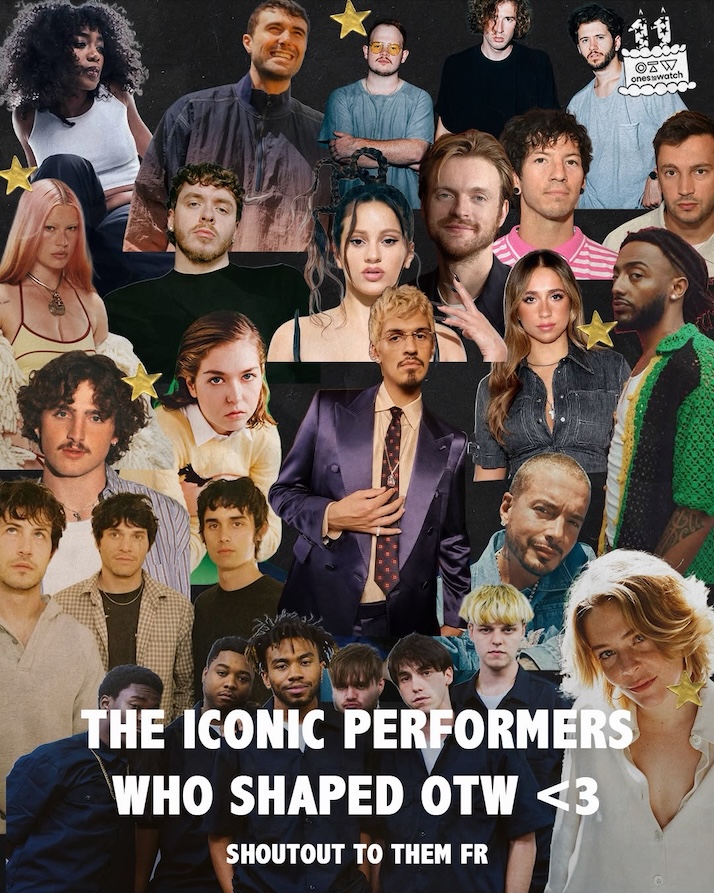
For the past 11 years, the Ones To Watch 101 has been a snapshot of artists on the verge of something big. This month, as we celebrate our anniversary and spotlight members of the 101 alumni community, we’re turning our attention to the performers who make the stage feel electric. These are the artists whose live shows linger long after the lights come up. The ones building worlds, creating moments, and reminding us why live music remains one of the most powerful forms of connection.
From sweaty club sets to festival-sized spectacles, these alumni have mastered the art of turning songs into experiences, and we’re thrilled to celebrate them.
Maggie Rogers
Maggie Rogers makes change feel like something worth leaning into. Ever since “Alaska” caught Pharrell Williams’ attention while she was still at NYU, she’s moved through folk, pop, and dance music with an instinct that prioritizes feeling over formula. Across Heard It in a Past Life, Surrender, and Don’t Forget Me, she’s written from a place of constant recalibration, where each era sounds like a new way of understanding herself. Her most recent work continues that thread, shaped less by reinvention than by a steady willingness to let go.
Snail Mail
Lindsey Jordan’s Snail Mail project thrives in emotional specificity, where small moments carry outsized weight. Lush introduced her as a defining voice in indie rock’s modern wave, and Valentine expanded that world with fuller arrangements and sharper emotional edges. Rather than softening with time, her writing has stayed direct, often circling the tension between clarity and uncertainty. Even as her sound continues to develop on stage and in new material, the core of her work remains rooted in emotional honesty that doesn’t look away.
Tate McRae
Tate McRae moves like someone who understands both precision and impulse. The precision from her dance background shows in the tight construction of her pop eras, but the emotional looseness inside these structures gives her music its pull. From early viral breakthroughs to THINK LATER and beyond, she’s sharpened a sound built on clean hooks and messy feelings. Her current era leans further into that contrast, turning personal uncertainty into pop songs designed to hit both physically and emotionally.
Benson Boone
Benson Boone sings as if he’s fully committed to every word, which is a big part of why his rise has felt so immediate. After first gaining attention online, Fireworks & Rollerblades introduced a voice built for scale, balancing arena-sized ballads with more restrained moments of reflection. His newer material, including the American Heart era, leans further into that dynamic range without losing its emotional center. What makes him stand out is how unguarded everything feels, even when the production gets bigger around him.
ROSALÍA
ROSALÍA treats genre less like a boundary and more like raw material. From El Mal Querer to MOTOMAMI and into her orchestral, concept-driven album LUX, she’s consistently reshaped what pop can hold without losing the rhythmic instincts that anchor her work. Singing across languages and styles, she builds songs that feel as much cinema-driven as they do musical. Each era expands her vocabulary rather than replacing it, creating a catalog defined by transformation that never feels random.
UMI
UMI’s music moves with a kind of quiet clarity, where softness is a deliberate choice rather than a limitation. Drawing from R&B, soul, and gentle folk textures, her songs often feel like internal dialogue set to melody. Projects like Forest in the City and talking to the wind established that meditative space, and her recent releases continue to stretch it subtly rather than dramatically. There’s a stillness in her work that makes even the smallest emotional shifts feel significant.
Omar Apollo
Omar Apollo shifts between genres with a kind of ease that makes boundaries feel irrelevant. R&B, funk, pop, rock, and Latin influences all surface across his work, anchored by a voice that moves between fragility and confidence without warning. Ivory introduced his emotional openness on a larger scale, and God Said No pushed that further into heartbreak, distance, and self-exposure. His strength lies in how unforced it all feels, as if every stylistic turn is guided purely by instinct.
Aminé
Aminé approaches rap with a sense of curiosity that keeps his catalog unpredictable. From the breakout impact of “Caroline” through Limbo and his collaboration with Kaytranada on KAYTRAMINÉ, he’s shifted between humor, introspection, and groove-driven experimentation. His most recent major project leaned into that collaborative energy while still centering his perspective as a writer. What makes his music land is the balance he maintains between lightness and detail, where jokes and reflection often sit in the same line.
Jack Harlow
Charisma defines as much of Jack Harlow’s presence in pop rap as his craft. He broke through with “WHATS POPPIN,” then pivoted toward a more stripped-back and reflective approach on Jackman., where the focus shifted from viral momentum to tighter storytelling. Since then, he’s continued working through singles and features while refining how he positions himself within hip-hop’s mainstream lane. His delivery remains conversational, which is part of why even his sharpest lines feel effortless.
Fred again..
Fred again.. builds electronic music out of fragments of real life. Voice notes, casual recordings, and fleeting moments become the foundation for his Actual Life series, where structure often feels secondary to emotion. That approach extends into his live shows, which blur the line between DJ set and shared experience. Rather than positioning dance music as escapism, he frames it as documentation of connection in real time, where the audience and artist end up occupying the same emotional space.
Noah Kahan
Noah Kahan writes like someone trying to make sense of where he came from and why it still matters. Stick Season turned that perspective into a defining modern folk record, later expanded through Stick Season (We’ll All Be Here Forever). Constant touring and streaming momentum have shaped the project’s longevity, keeping it culturally active well beyond release. His writing is highly specific, rooted in place and memory, but it’s that exactness that makes it easy for listeners to see themselves in it.
Gus Dapperton
Gus Dapperton’s music lives in contrast, where stylized presentation meets emotionally grounded songwriting. Early tracks established his offbeat vocal phrasing and aesthetic identity, while albums like Orca and Henge brought more structure and clarity to his sound. His recent work continues to smooth those edges without losing what makes it recognizable. There’s a careful balance in how he presents himself, where personality and production feel inseparable.
FINNEAS
FINNEAS moves between two roles with unusual ease: producer behind some of pop’s biggest records, and solo artist with a quieter, more restrained voice. While his work with Billie Eilish has shaped much of modern pop’s sound, his own projects, including Optimist and For Cryin’ Out Loud!, focus on intimacy and lyrical precision. His solo material favors space over excess, letting small details carry emotional weight. That duality defines his place in music right now, operating both inside and outside the spotlight.
Wet Leg
Wet Leg introduced themselves with a debut built on repetition, irony, and tightly controlled chaos. Songs like “Chaise Longue” turned deadpan humor into something immediate and undeniably catchy. Since then, they’ve continued touring and expanding the world of their debut without abandoning its core identity. They demonstrate strength through their restraint, arranging minimal elements in a way that feels unpredictable, despite the surface simplicity of their formula.
Twenty One Pilots
Twenty One Pilots have built one of modern music’s most detailed narrative ecosystems, where each album functions as part of a larger mythology. Across Blurryface, Trench, and Clancy, Tyler Joseph and Josh Dun have blended rap, rock, pop, and electronic elements while constructing a visual and thematic universe that continues to grow. Most recently, the pair showcased this deeply intricate and intimate bond on the AMA stage by performing their recent viral single “Drag Path,” enhancing their ongoing cultural presence with their moving performance. Beneath the concept work, the emotional core remains focused on anxiety, identity, and survival.
Wallows
Wallows occupy a space where nostalgia and modern indie pop meet in constant conversation. Early momentum from tracks like “Pleaser” led into Nothing Happens, Tell Me That It’s Over, and Model, each one refining a more polished and synth-driven approach. Their songwriting stays rooted in everyday emotional friction, often capturing relationships in motion rather than resolution. Across eras, they’ve strengthened themselves sonically without losing the conversational tone that first defined them.
The Band CAMINO
The Band CAMINO made their mark in the pop-rock zeitgeist by designing music around emotional immediacy. Their early EPs built a dedicated following, later solidified by their self-titled album, which sharpened their balance between guitar-driven energy and pop structure. Often centering their work on relationships and distance, they deliver hooks that are built to land quickly but linger. As they continue touring and releasing new material, their sound stays anchored in accessibility without feeling static.
J Balvin
J Balvin has played a defining role in bringing reggaeton into global pop circulation. After breaking through internationally with albums like Vibras and Colores, he helped shape how Latin music moved through mainstream pop spaces. His collaborations span genres and regions, reinforcing his position as a connector rather than a stylistic outlier. Across his career, he has consistently pushed reggaeton outward, making it part of a broader global sound conversation and paving the way for other reggaeton artists to be in the spotlight at last.
BROCKHAMPTON
BROCKHAMPTON first emerged as an internet-born collective that reimagined what a hip-hop group could look like in the streaming era. Across their critically acclaimed Saturation trilogy and later projects like Ginger and ROADRUNNER, they combined experimental production with deeply personal writing from multiple perspectives. Their work often felt like both collaboration and tension in motion. After disbanding in 2022, their incredible catalog remains a defining example of how group identity can function in modern hip-hop.
![In Conversation: The Band CAMINO x In Color [Q&A]](https://s3-us-west-2.amazonaws.com/onestowatch-v2/band_camino_x_in_color-1788906224.png)
![Getting To Know Scarlet Rae [Q&A]](https://s3-us-west-2.amazonaws.com/onestowatch-v2/scarlet-pic-15-1788474047.png)
![Pukkelpop 2026 Was One For The Ages [Festival Recap]](https://s3-us-west-2.amazonaws.com/onestowatch-v2/e_u_r_o_s_u_m_m_e_r_r_r_r🐬☀️🌺🌊-1787593374.jpg)