
Chelsea Jordan Is Just Like You [Q&A]
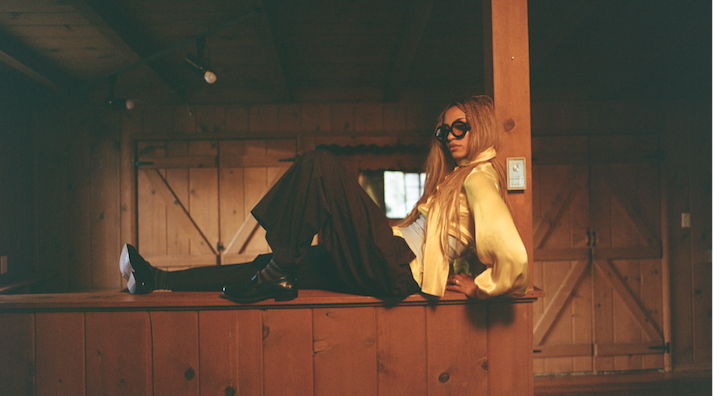
Photo by Hunter Lyon
Baltimore, MD-born singer-songwriter Chelsea Jordan has formed her musical identify by leaning into the styles of music she has spent much of her life captivated by, as well as establishing autonomy of her personal life. A clear disciple of Amy Winehouse, Jordan’s luxurious contralto naturally quivers and quakes as she maneuvers through her tunes, many of which offer fragments of thought surrounding an affirmation she seeks to fully internalize.
Her latest project better late than not at all comes in the aftermath of a prolific relationship; one that saw her forego elements of her being for the betterment of her now former partner. While the songs themselves provide insight into her mindset during and after these events, its visual elements display Jordan, a fashion-forward artist and curator in her own right, as having returned to her feminine. This adds consequential layers to the questions she poses, both to herself and to the listener, and the conclusions she hopes to draw from them on songs like “if I’m lucky” or “halfwaythru.” The former acknowledges her sensitivities but does not linger on them. In fact, she celebrates the idea of dismissiveness in her personal life, claiming that not everything is meant to be permanent.
Focus single “picky choosy” is undoubtedly her career best thus far. It embodies and emphasizes Jordan’s musical tastes and charisma, though the latter is significantly accentuated. She instinctively and freely rides the wave of the progressive R&B/neo-soul-style instrumental underneath her, allowing the snappy smoothness of the music to guide her: “I’m a good girllll, and I dress niceeeeee/ I keep to myself, I’m a good timeeee/ I got a lot of love to give, and I’m not gonna wasteeee itttttt.” The accompanying music video for the track, which sees Jordan goofing off in the kitchen, and politely passing on the advances of a male suitor in favor of a night in with her girls, is yet another component of her successful attempt at highlighting her self-sufficiency.
She hit the road as the opening act for Australian hitmaker Ruel this past winter, performing a set with implications of a jazz revue alongside her musically proficient bandmates. A cover of Justin Bieber’s “YUKON” saw her convert the pop standard to her liking, and was a refreshing step out of the box of frequently done material compared to many of her contemporaries. She would win the crowd over with her originals as well, as songs like “halfwaythru” and “1 on 1” possess resounding elements of relatability too potent to the be ignored.
OnesToWatch: What impact, if any, did the Baltimore scene have on you?
Chelsea Jordan: Baltimore has so much culture, and a lot of incredible music comes out of there. For me, being an athlete, I spent so much time focusing on sports and being in my little Baltimore bubble that I don’t even think I was introduced to that side of the city until I left it. I’m so incredibly grateful to have grown up in Baltimore, and not LA, if I’m being honest. LA feels like Disneyland.
Your voice is reminiscent of artists like Amy Winehouse, Norah Jones, and Alessia Cara. You even have a “tears dry on their own” reference in “halfway thru.” Did you inherit the elements of that style of voice from your tone, or is that vibrato something you had to really work on?
I listened to sooooo much Amy growing up that I always said that she was my vocal coach. However she sang, I just learned to sing like that. Not because I was trying to BE Amy, but because that soul, jazz-influenced stuff was all I listened to. That’s what I was studying. I don’t even realize how much vibrato I use until I get asked questions like this… it’s almost a comfort thing that I do.
From your opening set for Ruel, it is clear you are very big on live instrumentation and camaraderie with your bandmates. Can you recall a performance you watched growing up that inspired your love of authentic musicianship?
Growing up, a lot of the performances I watched were of Michael Jackson recordings, and a lot of Amy’s. Every performance she has done, I’ve watched. She has such a raw way of performing that really speaks to the music. There are certain performances of her just staring up at Blake, her ex-husband, and she doesn’t look at the crowd once. It’s moments like that that I realize that her music is just HER. It’s FOR her, it’s not for anyone else. The way she performs, her movements. It’s a very freeing experience to watch someone perform who just doesn’t care at all about what other people think.
What are the first steps you take while interpreting a song like “YUKON”?
The way that Justin sang it at the Grammys was just so raw, and I like that his eyes were shut the ENTIRE time. But, I think for a song like “YUKON,” which is just this freestyle kind of song, I’ll sing it differently every time. I don’t think I have one specific way of doing a cover. It’s just really about how I’m feeling that night. Maybe I want to use more vibrato, or elongate certain words. I go off my guitar player, Jack. I feel like we have really good chemistry onstage, so knowing that I can trust him to lead me gives me the comfort to do whatever I want.
In your NY Archive interview, you talked about how your music tends to shift sonically as your life happens. What’s the one thing, or the multifaceted number of things, that are influencing where your sonic development is at right now?
Right now, I’m influenced by very organic sounds. Everything needs to be played live. I don’t love programed drums on the computer. When I walk in the studio, a lot of producers will be like, “So, what’s the reference for today?” and I’m like, “There IS no reference. Just start playing chords and I’ll tell you if I like them.” But, I very much base every session off of how I’m feeling that day. Sonically, lyrically, it doesn’t really matter. Everything is always shifting, and I think that’s what I like about my music. There isn’t ONE sound I’m gravitating towards. Artists are consistently put into boxes… they’re called genres [said with a smile], and I don’t think it’s fair to do that.
What are the most evident differences between this project and your last, and why do think those differences were necessary?
I was writing BETTER WHEN I’M LONELY from a very confident but naïve standpoint. I was single for six years, so I was able to be selfish for six years. This project was about how I was in this relationship, and now I’m leaving this relationship, so it’s bringing me back to BETTER WHEN I’M LONELY. I reference that project here and there, because there is so much comfort that that project brings me. But, artistically, I think that BWIL is just my little baby. The first version of me putting out music that I’m so far removed from now, but I’m so grateful it exists because of the themes and patterns that are still such a big part of my life today. Overall, I just think the music, and my voice, are getting much more developed. I have a lot more confidence, and I think that shines through on this project.
Many artists will dismiss their first project when they put out their second. What’s it like to sprinkle some of the context from BWIM into this latest one even if the sound is different?
I honestly like that a lot. I love having a little ode to that project, and I would be crazy to dismiss it. I’m so big on inner child and having different versions of yourself that consistently live with you, even if you don’t identify with that in the present moment. Writing that project manifested the relationship I was in, and then that relationship influenced this project. And, one of my favorite things is when fans bring up my old project, and they’re an OG listener of that. It’s still resonating with people, and I want to continue to care about it.
What do you think your current state of fashion says about where you’re at artistically, sonically?
My sense of fashion consistently changes. Right now, I’m going for more of a fitted look than what I usually do. It’s my feminine energy trying to find its way out. In my relationship, I carried a lot of masculine energy, and that was reflected in the way I dressed. I’m dressing more feminine now, wearing tighter clothes that aren’t too revealing, but just keep me comfortable. I’m super inspired by Lenny Kravitz. I love a flair jean that’s a bit more fitted, and before I would have never EVER worn any jean that the slightest bit skinny.
Do you feel the desire to dive into your feminine reflected in the visuals and aesthetics of this project?
Definitely. My cover art specifically is very feminine. The way I’m covering myself, but my shoulders are showing. I wanted that to throw people off, because none of my previous art has been all that feminine.
Do you develop your arrangements to enhance the auditory experience, or is it the other way around?
Instrumentation is so important to me, in terms of it fitting with my voice instead of overshadowing it, because I do want my voice to be the main instrument. I don’t think it’s reliant on the instrumental side, but chords are so important to me. Like, I HAVE to sing over beautiful chords for me be to able to even find melodies. A lot of my production could be considered pop-leaning, but it’s the vocal that has the soul. I want that to be the most consistent thing, even if the production doesn’t necessarily make it a “soul record.”
What does your dream “picky choosy” live performance look like as far as staging, aesthetic, and wardrobe?
I don’t think my shows will ever be that extravagant. I love a super raw performance. Similar to Amy, I’d love to have backup singers and a horn section one day. What I’m wearing, I’d want it to be elegant but comfortable... a swaggy, simple outfit. That’s how my energy shines through the best, is when I’m physically comfortable. I just want people to feel like I’m accessible, not like I’m on a completely different level and no one can reach me. I want people to think, “She’s just like me,” because that’s how I FEEL. I feel like a regular girl who makes music and is just starting to do well.
Several of these songs talk about rationalizing and moving on from the past. What is the process of finding your way past those moments?
The songwriting is the biggest relief and release of the things that weigh me down. It’s the best therapy I’ve ever had. When I go into a session feeling really heavy about something, and I write about it and can go back and listen to it over and over, it’s how I process what has happened. I feel lighter. Everything that is happening to me, or that I’m experiencing, I’m just going to turn it into a song so that it’s worth it and can live elsewhere. Whether it’s super high highs or low lows, the fact that I have music is the most comforting thing.
What’s your idea of translating the idea of “I don’t want mixed signals or drama, I just want the truth” into music?
“If I’m lucky” is about me having a crush on this guy who was really just bad for me. I was like, “I just want to have a crush on someone, so you can lie, as long as it’s to my face. As long I’m SEEING you.” The song is just a silly bop about how not everything has to be serious in this relationship, or even this project. So much of my project feels serious, because it’s about a breakup, but this is my one ‘relief’ song where I’m like, ‘Eh, I’m gonna have a lot of crushes in my life, and if I’m lucky, I have some time to waste.’ My music is so honest. Even this song is semi embarrassing, but it’s just how I’m feeling, so I’m gonna write about it. Not sugarcoat it or fabricate it.
What does establishing independence on “halfwaythru” mean to you?
I was raised to be a very independent women. My parents instilled that in me at such a young age. Because I’m so independent, I tend to attract people who want a lot more from me than I can give them. I don’t want to babysit someone. I can do everything for myself, and that gives people the comfort to think they don’t have to do anything for me, which is just not the case. “halfwaythru” is a really liberating song about how I AM independent, and how I know what I want and what I like, and I’m not gonna let someone else change that or make me feel bad for being that way. I like those things about me, and that person loved those things when they first met me. I can’t be with someone who isn’t just as independent as me, and I think “halfwaythru” taught me that.
What are you hoping people take away from this project?
The title, better late than not at all, is the biggest thing I want people to take away. It’s ok to have been in a relationship where you weren’t treated the way you wanted to be. It’s ok to take your time leaving, as long as you do at some point stand up and leave. Leaving my breakup was so hard, and it happened way later than it should have. Nothing explicitly bad happened, and it’s a lot easier to leave when someone cheats or you’re fighting all the time, and you can pinpoint why you need to leave. I was just so unfulfilled. Through the process, I had to show myself a lot of grace. It’s better to leave at some point, whether it’s late or early or right on time, than to not leave at all and settle for something that is not what you deserve. So, that is what I want people to take away from this project.
Listen to "better late than not at all" below:
![Allow Blake Proehl To Introduce Himself [Q&A]](https://s3-us-west-2.amazonaws.com/onestowatch-v2/esther_kim-1793054130.jpg)
![How brookelen Found Her Own Light In dark side of the sun [Q&A]](https://s3-us-west-2.amazonaws.com/onestowatch-v2/brookelen_dark_side_of_the_sun_artwork-1792770775.jpg)
![How Whitney Whitney Lost Her Voice And Found A New Sound On ‘1.3’ [Q+A]](https://s3-us-west-2.amazonaws.com/onestowatch-v2/whitney_whitney-_lead_press_photo(_credit__sol_koi)-1792710354.jpg)