In Conversation: Alemeda and Donna Missal [Q&A]
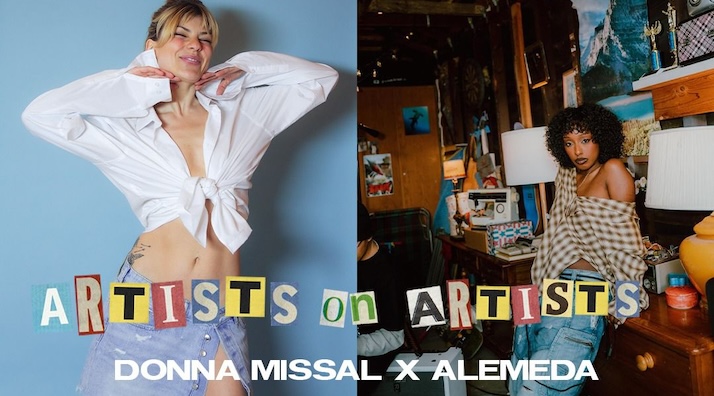
In celebration of our 11th anniversary, Ones to Watch turned to 101 of our favorite artists, asking them to point us to the next generation of musicians ushering the culture into its next chapter. For Donna Missal, Ethiopian-American genre-bender Alemeda is at the head of the vanguard.
Missal, a singer-songwriter long praised for her emotional precision and raw vulnerability in her own work, was drawn to Alemeda’s dauntless creative presence and resonant songwriting. The two sat down for a conversation, discussing each of their creative approach and rejection of labels.
Their exchange centers on artistic identity, genre fluidity, influence, and the realities of navigating the music industry as a Black woman in alternative music. For decades, Black artists have helped shape the genre’s sonic language, visual world, and rebellious spirit —from the Bad Brains to the Santigolds and the Rihannas—alternative rock has been amplified by the power of Black voices.
In Alemeda, Missal sees an artist pushing that lineage forward — not by asking for permission, but by expanding the terms altogether.
Donna Missal: How do you like to be referred to, like, in life? What should I call you?
Alemeda: Like my name?
Yeah. Do you like being called Rahema outside the context of music? Do your friends call you Alemeda? Rahema?
You know what? I think I've trained everyone to call me Alemeda.
Yeah, I have that too. So, your whole network is all just people you met through music?
Basically. Specifically within my management. How about you?
My name is Donna. Like, that's just my name. Someone asked me the other day when I decided to use my real name as my artist's name. And I didn't really have an answer. I never asked myself that question. Like, ‘Should I have an artist's name?’ I didn't even know I had an option at the time. It was a long time ago. Haha.
Okay. I was stressing about that. I was literally like, “I can't do Rahema because it sounds like Rihanna.” But, Alemeda is my last name.
I did read that. Was it an easy decision to go by your last name?
For the longest time, I felt like I made the wrong decision, and then as people started to actually love my work, I was, like, “Dude, your name is amazing. It's so cool and unique.”
Why did you think you made the wrong decision?
I don't know. It's Ethiopian. So, I just didn't know if it would be easier to use an English name. You know what I mean? It was about what other people thought, not me.
That's the crux of artistry. At what point do you start taking into account the way you are perceived by other people? Because I know that's a big problem for artists who write their own music. It seems that you are extremely involved in what you do. From the visuals, the music, the production, the genre, the aesthetic. It’s all coming from you, and you are dictating these decisions, right?
I noticed an extreme difference in when I did the art just 'cause I was having fun, and I wanted to do it, versus when I was like, “Okay, this is what people want from me.” I think anytime I made a song where it's just me having fun, it's always received better.
At what point in your process are you thinking about others’ perception: while you are creating, or is it when you're finally ready to share what you've created?
I did, and then I was like, “Never mind, I don't care anymore.”
Haha!
Also, I feel like people's perceptions are so unnecessary. With music, people think ‘one plus one equals two.’ But, I've had whole discussions with my friends where they're like, “I think this song is ass.”But you actually think it’s the best song ever. It's all feelings and opinions.
Yeah. Completely subjective. There's something for everyone.
So, listening to people's opinions on things…it would be kind of stupid.
For sure. Especially in the scope of your long-term artistry. Ultimately, if you want to succeed at something, you would want it to be something that you genuinely believe in.
Yeah…
You see that a lot. It's really common, I think.
It is. I feel like it was way more common when we were younger, in the 2000s, 'cause I feel like they had no control. How long have you been making music?
I've been making music for over 10 years now. So, it's been a long time. I've seen myself through a lot of different eras and shifts in the industry and in the culture. But also, my own process has shifted a lot through the years. I wanted to ask you, because you seem like someone who probably faces this a lot – I'm curious about you and your relationship with genre, and what it means to you to be categorized as alternative?
I feel like anyone who grew up in the 2000s or 90s knew rock as the most prominent genre. The same way where from 2013 to now, I guess, hip-hop was the most prominent genre. When I was growing up, I felt like it was rock. Wherever you go, whether it’s the mall, watching a commercial, a theme song, they were all rock songs.
I never grew up listening to a lot of music because my mom was super religious. So, when I got older, I started to discover all these bands, and I was so influenced by rock. The relationship with being labeled an alternative artist has been really weird for me. I know it comes with this expectation of me to be making hip-hop or R&B.
I just know all the stories of the artists before me, like the Fefe Dobsons, the Santigolds, the people who were making amazing alternative music and were Black women, and were being categorized or told that their music is not good - just for it to be sold to big, pop or rock girls. I love R&B, but my influences are Paramore and SZA. So it's been a battle for me.
I think it’s going to take artists like you — artists who are unwilling and unrelenting, and not willing to accept the narrative placed around you. Even someone like Rihanna — I feel like, in the future, we’ll be able to recognize these women as so much more than the genre they were categorized in. She is a rock star to me. Anti was a genreless album. So I feel like it’s going to be on the backs of artists like you that people in the future won’t have to face those same boundaries.
Do you have a perfect 10 album? You know how Pitchfork has its perfect 10s.
It would be a tie between AM by Arctic Monkeys. Yeah, it’s the poppiest one, but I don’t give a fuck. I hate people who hate pop music. They want everybody to be underground and unsuccessful so badly.
The other one would be Ctrl by SZA. Another genreless album. They immediately categorized that as R&B, but the majority of that album is extremely folky, alternative, and pop. She is a pop star. The only R&B song was “The Weekend.” That’s how they get you.
She definitely was one of the pioneers for a Black woman doing some different shit — unconventional music. Do you have a dream collaborator who would feel validating in that way?
It would definitely be Hayley Williams. Fuck yeah. That would be the one. I always say that’s my dream. If I get that collab, I’ve done everything I needed to do.
She’s one of the best vocalists of our generation, hands down. I feel like that’s not talked about enough. There’s something about the aesthetics of pop-rock that has delegitimized how serious of a talent she is.
Yeah, exactly. I feel like that still continues to be the case, especially for women.
I almost feel like that’s part of what has shaped your visual aesthetic, too — this unrelenting, “I don’t care what presumption this is going to lead to.” It almost comes off as a bit of a “fuck you” in a really powerful way.
Yes. Because that’s the vibes here.
I was just talking about how women who look a certain way don’t get taken seriously. Their art doesn’t get taken seriously. If you’re too flashy or the production is too high, you’ll be called an industry plant.
For sure. I love wearing makeup. I’ve literally been wearing makeup since I was 12 — full face. Sometimes I think about whether I’ll be taken less seriously with the music I make because of how much makeup I wear. That’s a thing I have to think about, versus men can just look any type of way, be any type of weight.
What wasn’t being understood when you were talking about that?
They were looking at it from everyday life, and I was looking at it from the perspective of an artist. As an artist, it feels like you’re being judged by a different metric.
Do you feel like your image as an artist is part of the artistry, or is it just who you are?
I think it’s myself. It might be something that I put on, but it’s still myself in a way of what I want to be.
I have a song called “Gonna Bleach My Eyebrows,” and it’s basically like: reinvent yourself, don’t be scared to start over. People come up to me and say that song changed their life, and I’m like, same. I made that song for myself, too. I literally listen to it for myself.
Sometimes, who I am when I get onstage is like I’m performing the version of myself that I’m reminding myself to be. These songs are for me to remember that. When I sing them and perform them, it’s like I’m emulating that version of myself that I want to be. It’s not a character. It’s still me.
So it’s not an alter ego — more like an amplified version of yourself.
Yeah. When you’re performing, those are your people. They resonate with what you put out. My fan base is really nice. They get my cat toys and shit. So for me, it’s that space where I can really do all that.
Did performing take time to feel natural?
Yeah, because my career started with COVID. I signed with my manager, and then boom, COVID happened two months later. So I didn’t get to perform. I had put out all these songs, some of them had gotten attention, and I had listeners, but they had never seen me perform.
So I went to USC and did an open mic. My song was already doing well on TikTok, and I was getting a few offers to open college shows, but I was like, I can’t do that — I’ve never performed my own music.
I was terrified. My publicist was literally grabbing me like, “No, you can’t run out the door.” I was shaking. I was genuinely having a panic attack. Then I went up there and performed, and I was like, “Oh, this is not that bad.”
It just feels like such a strange time for artists to be developing in front of an audience that already expects them to have it all figured out.
What you’re doing is really inspiring — standing in the face of expectation and saying, “I’m not going to give you what you expect. I’m going to be me,” and having that translate to fans who really understand you. It feels like a new frontier, and it feels like you’re on the cutting edge of it.
Listen to Alemeda below:
![Sofia Camara Shares What She’s Learned On New EP ‘Still Somewhere Here’ [Q+A]](https://s3-us-west-2.amazonaws.com/onestowatch-v2/main_press_photo(credit__andré_tentugal)-1792182185.jpg)
![wakelee Are Learning to Live With the Unfinished Parts of Themselves [Q&A] | THE NOISE](https://s3-us-west-2.amazonaws.com/onestowatch-v2/unnamed-1792091490.jpg)